By Mahmud Tim Kargbo
Wednesday, 3 June 2026
International justice rests upon a simple but indispensable principle: allegations must be supported by evidence. When governments begin treating suspicion as proof, inference as fact, and diplomatic frustration as a substitute for judicial findings, the credibility of international cooperation itself comes into question.
That principle lies at the centre of the growing dispute between the Netherlands and Sierra Leone over Dutch fugitive Jos Leijdekkers, widely known as “Bolle Jos”. What began as a law enforcement matter concerning one of Europe’s most wanted criminals has increasingly evolved into a broader political and diplomatic controversy involving development assistance, international reputation, state sovereignty, and the standards by which nations are judged in the court of global opinion.
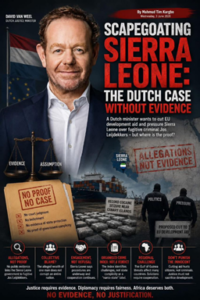
The Dutch Government is fully entitled to pursue Leijdekkers through every lawful avenue available to it. No serious observer disputes that proposition. States have a legitimate interest in apprehending convicted criminals, dismantling transnational trafficking networks, and protecting their societies from organised crime. The challenge arises when the pursuit of an individual suspect begins to expand into allegations against an entire country without a corresponding public presentation of evidence.
Recent reporting by NL Times (https://nltimes.nl/2026/06/01/dutch-govt-will-try-cutting-eu-development-aid-sierra-leone-bolle-jos), DutchNews (https://www.dutchnews.nl/2026/06/government-pushes-eu-to-cut-sierra-leone-aid-over-drug-smuggling/), and Daily Dutch News (https://dailydutchnews.nl/netherlands-eu-aid-sierra-leone-bolle-jos/) has highlighted statements by Dutch Justice and Security Minister David van Weel suggesting that the Netherlands may seek support within the European Union to reconsider development assistance to Sierra Leone. According to those reports, Van Weel described it as “bizarre” that European taxpayers continue supporting a country allegedly providing sanctuary to a major criminal while extradition efforts remain unresolved.
The seriousness of these statements cannot be overstated. Development assistance is not a symbolic instrument. It affects real communities, real institutions, and real people. It influences education, healthcare, food security, governance reforms, infrastructure development, and economic opportunities. When a European government publicly advocates using aid as leverage against a developing country, the issue extends beyond one fugitive. It enters the realm of international affairs.
At the heart of this debate lies a fundamental evidentiary question. What precisely has been proven? The available public record demonstrates that Dutch authorities believe Leijdekkers has been present in Sierra Leone. It demonstrates that Dutch officials are frustrated by the pace of developments surrounding his apprehension. It demonstrates that serious allegations have been made concerning his activities and possible connections.
What the public record does not presently demonstrate is equally important. No publicly available judicial finding has established that the Government of Sierra Leone knowingly provided sanctuary to Leijdekkers. No court ruling has concluded that Sierra Leonean institutions participated in his alleged criminal activities. No indictment has been issued against Sierra Leonean officials for facilitating his operations. No publicly disclosed evidentiary record has established state complicity in narcotics trafficking linked to Leijdekkers. These distinctions are not procedural technicalities. They are the foundation of the rule of law itself.
Throughout modern legal history, democratic societies have insisted upon a separation between allegation and proof. Courts exist because accusations require scrutiny. Investigations exist because suspicions require verification. Due process exists because governments can be mistaken, witnesses can be unreliable, and assumptions can be wrong. These principles apply not only to individuals but also to states. Indeed, they become even more important when allegations risk damaging the reputation of an entire nation.
The language employed in some of the Dutch reporting deserves closer examination. Much of the narrative relies upon formulations such as “reportedly”, “believed to be”, “in our estimation”, and “everyone knows”. These are not evidentiary terms. They are inferential terms. They may indicate suspicion, concern, or probability. They do not establish proof. This distinction becomes particularly important when considering one of Van Weel’s most widely quoted statements regarding a major cocaine seizure linked to a vessel that allegedly departed from Freetown. “If you look at the amount of drugs that came off that ship, it cannot be true that cooperation with this operation was not provided across all levels.” The implication is clear. The scale of the operation, in the minister’s view, suggests participation beyond individual actors.
Yet the statement itself illustrates the gap between inference and evidence. Neither the minister nor the reports citing him have publicly produced judicial findings, indictments, investigative disclosures, financial records, or other verifiable evidence identifying the alleged participants or establishing institutional involvement by the Government of Sierra Leone. The conclusion is asserted. The supporting evidence remains largely undisclosed.
Similarly, the frequently cited assertion that “everyone knows” the shipment originated in Freetown may carry rhetorical force, but rhetoric is not evidence. International law, criminal justice, and diplomacy all require standards more rigorous than collective assumption. The distinction is particularly important because of the broader implications involved.
The Netherlands is not merely seeking the arrest of a fugitive. It is reportedly exploring ways to mobilise European institutions against a sovereign state. Such actions raise questions extending beyond Sierra Leone. Should development assistance be conditioned upon satisfying the expectations of individual member states in unresolved criminal matters? Should diplomatic pressure be applied before publicly available evidence establishes institutional culpability? Should allegations against a suspect be permitted to evolve into reputational judgments against an entire nation? These questions deserve serious consideration because the answers will shape future international practice.
The European Union’s development relationship with Sierra Leone is not designed as a reward mechanism for political compliance. According to the European Commission’s international partnerships framework for Sierra Leone (https://international-partnerships.ec.europa.eu/countries/sierra-leone_en), assistance supports governance reforms, economic development, energy access, food security, and social development initiatives. These programmes are intended to improve lives and strengthen institutions. If such assistance becomes contingent upon the political objectives of individual member states, the distinction between development cooperation and diplomatic coercion begins to blur. That concern extends far beyond Sierra Leone. It touches the credibility of European development policy itself.
The Dutch narrative also contains inconsistencies that deserve scrutiny. NL Times reported that the European Union allocated €325 million to Sierra Leone between 2021 and 2027, while DutchNews and Asatu News reported a figure of €352 million. Such discrepancies do not invalidate the broader discussion, but they reinforce the need for precision before punitive measures are proposed against an entire nation.
Equally striking are claims concerning Leijdekkers’ alleged income. Dutch reports quoted Van Weel as suggesting that the fugitive earns hundreds of millions of euros per month and that such wealth could overwhelm a country like Sierra Leone. Yet World Bank data show that Sierra Leone’s Gross National Income is measured in billions of dollars annually, underscoring the need for caution when making sweeping economic comparisons (https://data.worldbank.org/country/sierra-leone).
An equally important issue concerns the way organised crime assessments are being interpreted. The Organised Crime Index published by the Global Initiative Against Transnational Organized Crime (https://africa.ocindex.net/country/sierra_leone) identifies serious criminal threats facing Sierra Leone, including cocaine trafficking, corruption, human trafficking, environmental crimes, and illicit markets. Yet the same report also measures resilience, evaluating the capacity of institutions to respond to those challenges. This distinction is frequently overlooked. The existence of organised crime challenges does not automatically establish state complicity. If it did, numerous countries would face similar accusations.
The Netherlands itself has spent years confronting sophisticated narcotics networks operating through Rotterdam. Belgium has grappled with organised criminal activity linked to Antwerp. Italy’s struggle against Mafia organisations is among the most extensively documented law enforcement campaigns in modern Europe. Spain, France, Germany, the United Kingdom, and the United States have all faced serious organised crime challenges. Yet no serious analyst concludes that the mere existence of organised crime within these jurisdictions constitutes proof of governmental participation. The distinction between criminal infiltration and state complicity has always mattered. It should matter equally in Sierra Leone’s case.
Context matters as well. The Gulf of Guinea is one of the world’s most complex maritime regions. International security organisations have long identified the region as vulnerable to piracy, trafficking, smuggling, illegal fishing, and other forms of transnational criminal activity. These challenges affect multiple countries, including Sierra Leone, Liberia, Côte d’Ivoire, Ghana, Togo, Benin, Nigeria, Cameroon, Equatorial Guinea, São Tomé and Príncipe, Gabon, the Republic of the Congo, the Democratic Republic of the Congo, and Angola.
To portray narcotics trafficking as a uniquely Sierra Leonean phenomenon risks oversimplifying a regional challenge that transcends national borders. Transnational problems require transnational solutions. They require intelligence sharing, maritime surveillance, technical cooperation, institutional strengthening, and international partnership. That reality makes another aspect of the debate particularly noteworthy.
In January 2025, following international reports concerning Leijdekkers, Sierra Leonean authorities publicly addressed the issue through a briefing involving the Ministry of Information and Civic Education, the Sierra Leone Police, and the Office of National Security. Officials stated that investigations were ongoing and encouraged members of the public to provide information that could assist law enforcement efforts. The official government briefing can be found at http://www.moice.gov.sl/ministry-of-information-and-civic-educations-press-conference/. Reuters subsequently reported that Sierra Leone was investigating the allegations and engaging with international partners (https://www.reuters.com/world/africa/sierra-leone-says-investigating-reports-that-dutch-drug-kingpin-took-refuge-2025-01-26/). Voice of America, Euronews, The Guardian, and other international media organisations carried similar reports. These developments do not prove innocence. Nor do they establish guilt. What they demonstrate is that Sierra Leone publicly acknowledged the matter and indicated a willingness to investigate. That fact is important because some of the public narrative increasingly suggests outright refusal to cooperate.
The publicly available record paints a more complicated picture. The Dutch Government may ultimately prove correct in its suspicions regarding Leijdekkers. Additional evidence may emerge. Investigations may produce new findings. Legal proceedings may reveal information not presently available to the public. Those possibilities remain open. What remains absent, however, is publicly available evidence sufficient to justify treating Sierra Leone itself as culpable. International legitimacy rests not upon the forcefulness of an accusation but upon the strength of the evidence supporting it. The distinction is particularly important when proposed consequences extend beyond an individual suspect and threaten to affect an entire nation.
The central issue is therefore larger than Jos Leijdekkers. It is larger than David van Weel. It is larger than relations between Sierra Leone and the Netherlands. The issue concerns the standards by which states are judged in the international system. If evidence exists, it should be presented. If crimes have been committed, they should be prosecuted. If extradition is justified, it should proceed through established legal channels. But if international justice is to retain credibility, accusations must continue to be tested against evidence before they are transformed into policy. No serious democracy would accept a lesser standard for itself. No sovereign nation should be expected to accept it either.
Ultimately, the question confronting policymakers is not whether organised crime should be fought. It should be fought relentlessly. The question is whether the international community remains committed to evidence before judgment, law before pressure, and proof before punishment. No principle is more important to the integrity of international justice.