By Mahmud Tim Kargbo
A minister can inherit an office. He cannot inherit public confidence. Umaru Napoleon Koroma enters the Ministry of Employment, Labour and Social Security at a moment when expectations are unusually high because his career has given supporters and observers reason to believe that he can organise people, navigate institutions and pursue results. Yet MELSS is not another party secretariat, legal portfolio or mining assignment. Its success will be measured by whether people find work, whether workers are protected and whether citizens can depend on social security when circumstances turn against them. That is the harder test, and it is the test that will define his next chapter.
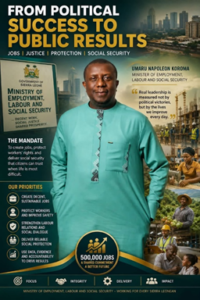
Napoleon’s record explains the expectations without requiring mythology. Before entering public office, he practised as a Barrister and Solicitor and served as Deputy Head of Chambers at Brewa & Co in Freetown. In September 2017, he became National Secretary General of the Sierra Leone People’s Party, a position he held through the party’s 2018 and 2023 electoral cycles before leaving the office in 2025. A Secretary General is not simply a political organiser: the position demands administration, coordination, negotiation, communication and the management of competing interests within an institution pursuing a common political objective. His record therefore provides reasonable evidence of organisational and persuasive ability, while making no automatic claim that success in party management guarantees success in public administration.
His public career subsequently moved through institutions with very different demands. In 2018, President Julius Maada Bio appointed him Chairman of the National Commission for Privatisation, placing him at the centre of governance and oversight involving state owned enterprises. He subsequently served as Deputy Minister of Justice before becoming Deputy Minister of Mines and Mineral Resources, a portfolio in which his legal background intersected with mining agreements, investment and resource governance. Parliament’s official record describes him as having served as Chairman of the National Commission for Privatisation and Deputy Minister of Justice before his appointment to the mining ministry. https://www.parliament.gov.sl/uploads/handsards/17TH%20AUGUST%202023.pdf The progression matters because each assignment required him to learn a different institutional language while relying on the same fundamentals of judgement, persuasion, coordination and execution.
His years as SLPP Secretary General should likewise be assessed with institutional fairness. The party’s return to government in 2018 and retention of power in 2023 were collective achievements involving candidates, party structures, supporters, voters and the wider leadership. It would therefore be neither fair nor analytically sound to attribute those victories to one official. What can reasonably be credited to Napoleon is eight years at the centre of the party’s national secretariat, including responsibility for keeping a large political organisation focused through successive electoral cycles. That experience could prove valuable at MELSS if political coordination is translated into professional management, measurable targets and disciplined follow through.
The ministry he now leads carries responsibilities that reach directly into the Government’s social contract with citizens. The Ministry of Employment, Labour and Social Security, https://moelss.gov.sl/, is responsible for developing and administering labour and social security regulations and policies, maintaining industrial relations, ensuring occupational safety and health and providing social security. The ministry also describes itself as a key driver of the presidential initiative to create 500,000 jobs during the current five year mandate. https://moelss.gov.sl/about-the-ministry/ Those responsibilities place MELSS at the centre of an economic question that cannot be answered by speeches: how does Sierra Leone turn a growing working age population into productive livelihoods? The World Bank estimates that Sierra Leone currently generates about 41,000 jobs a year, while roughly 75,000 new jobs annually are required between 2020 and 2050 merely to maintain the existing employment to population ratio. https://documents1.worldbank.org/curated/en/099061225111042666/pdf/P178865-455fb8a0-2316-450a-9c6e-503c97654281.pdf The scale of that gap should make employment delivery the ministry’s first discipline.
That requires Napoleon to establish an evidence culture from the outset. The ministry already operates a Job Tracker intended to connect job seekers, employers and policymakers, while providing labour market information and employment opportunities. https://lmis.moelss.gov.sl/ The decisive question is whether such systems become instruments of management rather than repositories of information. He should be able to ask which programmes create jobs, which sectors are hiring, what skills employers cannot find, how long newly created jobs survive and where public interventions are failing. A job should not become merely a number attached to a launch ceremony or government announcement. The real measure is whether employment is productive, sustainable and capable of improving the circumstances of the household behind the statistic.
The quality of employment matters as much as its quantity. The International Labour Organisation, https://www.ilo.org/, places Sierra Leone’s decent work agenda within a framework encompassing employment opportunities, fundamental rights at work, social protection and social dialogue. That gives MELSS a responsibility broader than counting new jobs. It must strengthen labour inspection, occupational safety, dispute resolution and engagement between workers and employers, while ensuring that regulations are sufficiently clear for businesses to understand and comply with. Workers must believe that their rights have institutional protection, while employers must know that rules will be administered consistently rather than selectively. The ministry’s authority will ultimately be judged not by the number of directives it issues, but by whether the workplace becomes safer, fairer and more predictable.
Social protection presents an equally practical test. The ministry’s Social Protection Directorate states that MELSS supervises the National Social Safety Net and the contributory pension scheme administered by the National Social Security and Insurance Trust, or NASSIT. https://moelss.gov.sl/directorate-of-social-protection/ For a household living close to the margin, however, social protection is not an institutional chart. It is whether assistance arrives when it is needed, whether eligibility is transparent, whether complaints are heard and whether a worker approaching retirement can trust the system into which contributions have been made. Napoleon should therefore demand measurable improvements in coverage, timeliness, accountability and grievance resolution. The test of social security is ultimately simple: whether citizens experience the state as dependable when they are least able to absorb a shock.
The ministry cannot solve the employment challenge alone. Sustainable job creation depends on investment, productive businesses, skills development, agriculture, manufacturing, services and the ability of firms to grow. The World Bank’s analysis shows that Sierra Leone’s private sector remains constrained by infrastructure deficits, the business environment and limited diversification, making job creation inseparable from broader economic reform. https://documents1.worldbank.org/curated/en/099061225111042666/pdf/P178865-455fb8a0-2316-450a-9c6e-503c97654281.pdf MELSS should therefore become a serious convening institution, bringing employers, workers, training institutions and other parts of government around practical employment problems rather than multiplying committees. Napoleon’s legal background can help him insist on clear rules and institutional accountability, while his experience in negotiation can help him reconcile interests that do not naturally align. The measure of that convening power will be whether it produces better labour market outcomes, not whether it produces more meetings.
His most consequential responsibility may therefore be the management of people inside the ministry. No minister can personally inspect workplaces, administer employment services, resolve labour disputes or supervise every social protection programme. His real leverage will come from the quality of the team he assembles, the clarity of the priorities he establishes and the standards to which senior officials are held. His persuasive skills will matter most if they produce professional ownership rather than personal loyalty, and if officials are confident enough to tell him when an initiative is underperforming. He should set a small number of measurable priorities, assign responsibility clearly, demand evidence and review results without sentiment. That is how a reputation for getting things done can become an institutional culture that continues to perform when the minister is not in the room.
There is also an unavoidable political dimension. The SLPP is approaching the 2028 transition election, assuming the constitutional and electoral timetable proceeds as expected, and the Government’s record by then will be judged increasingly through the everyday experiences of citizens. Employment, labour protection and social security are among the areas in which the social contract becomes tangible. A considerable section of the party therefore expects a senior figure associated with two successive electoral victories to bring the same determination to government delivery. That expectation is understandable, but it should not become a demand for political theatre. The strongest contribution Napoleon can make to the Government’s credibility is to ensure that MELSS delivers services and institutions that remain defensible even when political allegiance is removed from the equation.
The opportunity is therefore larger than a ministerial promotion.
Napoleon has already shown that he can help a political organisation pursue a defined objective. MELSS now gives him the harder opportunity to demonstrate that those qualities can build public institutions whose value extends beyond an election cycle. If jobs become more measurable, workers better protected, social security more dependable and the ministry more professionally managed, his record will acquire a significance that no political appointment can confer by itself. The political success that brought him to this office will then have become the beginning of a more demanding test: whether he can convert organisational ability into institutional performance. Public confidence, in the end, will not be inherited from the past; it will be earned by what citizens can see working in their own lives.