From Local Baker to Factory Owner
By Algassimu Monorma Bah
There are moments when progress is no longer an idea, but something you can see and feel. Standing at the newly expanded Sierra Leone Flour Mill, I knew I was witnessing one of those moments, but it was a story from the past that gave it meaning.
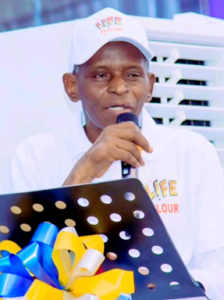
Alhaji Amadu Juldeh Sowe, now Chairman of the mill, spoke humbly about his beginnings. As a young boy, he would come to this very factory with his father, as customers. They came simply to buy five bags of flour for the week’s baking. Yet, like many at the time, they were not allowed inside the factory premises. They remained at the gate, waiting patiently for their goods to be brought out to them.
Years later, that same boy who had dropped out of school to support his father’s bakery business, is no longer standing outside or merely getting access inside the gates, but at the helm of the very factory he once could not enter, now presiding over its operations.
The facility itself tells a similar story of transformation. When Mr. Sowe acquired it in 2015, it was closed for a decade later, with lingering doubts on how to run it in the face of highly competitive imported flour. Now with government support, including key concessions such as additional land for expansion and policy incentives, the plant has now been revived and expanded, increasing its production capacity from 250 to 600 tons per day. But beyond the numbers, it is the symbolism that resonates: access, ownership, and change.
The significance of the moment drew national and regional attention. President Julius Maada Bio, who the owner praised for his leadership and unflinching hands on support to the project, attended alongside First Lady Fatima Maada Bio, some of his ministers, heads of parastatals such as Fodeba Daboh of the Local Content Agency, Members of Parliament, and delegates from Guinea and Liberia (a sign that this story now extends beyond Sierra Leone’s borders).
Sowe credited the government for creating an enabling business environment through policy reforms and tax concessions, particularly the waiver of import duties on wheat. He also acknowledged support from financial institutions both locally and internationally, including the World Bank.
World Bank Country Manager, Abdu Muwonge, described the project as a strong example of collaboration between government, development partners, and the private sector, noting its alignment with the Feed Salone Initiative of the Sierra Leone government.
The impact is already visible. Jobs are being created, supply chains are expanding, and with lower production costs, “Life Flour” is becoming competitive enough to reach markets in Guinea, Liberia and beyond.
President Julius Maada Bio later described the development as a milestone. One that strengthens local value addition and signals a commitment to private sector growth.
Standing there, one image stayed with me more than any policy or statistic: a young boy at the gate, waiting. Today, that gate is no longer closed to him, because he has the keys to open it.
And perhaps, in that simple shift, lies the real story of Sierra Leone’s industrial future. That if indigenous citizens take bold steps and work with courage, and perseverance, and with government support and expert advice and supervision, we will produce what we eat, and eat what we produce.
This wasn’t just another story. This was an inspiring historical moment.
@highlight #FEEDSALONE