Stakeholders have called for stronger protection and promotion of women’s digital rights in Sierra Leone, with specific emphasis on public awareness of existing laws, digital literacy, data protection and effective mechanisms for reporting violations.
The call was made on Tuesday, 18 August 2026, during a workshop on Women’s Digital Rights in Sierra Leone, organised by the Media Reform Coordinating Group (MRCG) at CCSL in Freetown.
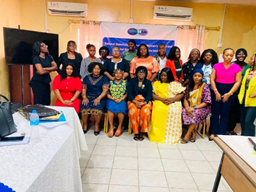
The workshop brought together representatives from Government, the media, civil society, legal and women’s rights organisations to discuss progress made in advancing women’s digital rights, challenges affecting their participation in online spaces and the responsibilities of relevant stakeholders in creating a safer and more inclusive digital environment.
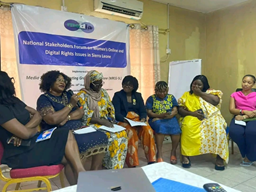
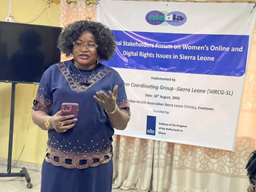
The Director of Government Information and Services, Francess Josephine Kafula, represented the Ministry of Information and Civic Education. In her opening statement, she posited that Sierra Leone’s digital transformation would not be truly transformative if women were allowed to enter the digital space only as users without being equally protected, represented, heard and empowered – “As digital technology becomes part of how we communicate, learn, do business, access government information, and participate in Public debate, we must ask a simple question: are women participating in this digital future on equal terms? Women’s digital rights should not be misconceptualised as the right to own a phone or open a social media account, but the ability to access information, express themselves, participate in meaningful activities, and use digital opportunities for education and economic advancement.”
The Director, however, noted that having access to a mobile phone or the internet does not necessarily amount to meaningful digital empowerment, stressing the importance of affordability, digital skills, safety, privacy, opportunity and participation.
She also highlighted the growing risks women face online, including harassment, cyberstalking, impersonation, threats, blackmail and other forms of technology-facilitated abuse.
She warned against dismissing online abuse as “only social media,” noting that digital violence can have real consequences for women’s safety, dignity, professional lives and participation in public affairs.
Director Francess further linked women’s digital rights to democratic participation, stressing that when women are silenced online, the consequences extend beyond the individual to the media, public discourse and democracy.
She called for women to be placed at the centre of digital policymaking, noting that they should not merely be consulted after decisions have been made but should actively participate in shaping policies, technologies and institutions that will determine Sierra Leone’s digital future.
When asked about the role of the Ministry in promoting women’s digital rights, she stressed that the Government cannot achieve this objective alone, noting the importance of partnerships and the role of grassroots structures in taking information to communities across the country.
The Director encouraged women who believe their digital rights have been violated to reach out to the appropriate institutions, while urging victims to follow due process and formally report cases so that they can be properly addressed.
She emphasised that a violation cannot effectively be dealt with if it is not reported, and encouraged women to become familiar with the laws protecting their rights and the institutions responsible for addressing violations.
During the first panel discussion, moderated by Madam Tucker and featuring Hawanatu, Sunkari and Zainab T., participants examined progress made in advancing women’s digital rights and the challenges limiting their participation online.
The panel recognised the Cyber Security and Crime Act and the Gender Equality and Women’s Empowerment Act as important developments in strengthening the legal framework relevant to women’s rights and participation.
Participants also highlighted the digital space as an important avenue for women’s empowerment through access to information, education, entrepreneurship, advocacy and public participation. However, they identified poor network connectivity, expensive internet connectivity, traditional gender norms, blackmail, fear of speaking, cyberbullying, inadequate implementation of laws and lack of awareness of existing legislation as major barriers to women’s meaningful participation online.
The panel noted that traditional expectations of women being submissive can discourage them from expressing themselves freely, while also acknowledging that women themselves can sometimes participate in cyberbullying and reinforce patriarchal attitudes against other women.
Participants expressed concern that although laws exist, many citizens remain unaware of their rights and do not know how to seek redress when those rights are violated.
A key recommendation from the panel was therefore the need to simplify laws relating to women’s digital rights and make them accessible to ordinary citizens, particularly at the grassroots level.
The mix of panelists also included Ms. Magdalene Esq, a legal representative from CARL, SLAJ Public Affairs Secretary, Madam Humu Hawa Bakarr, President of Women in the Media, Mrs Tucker, a South-East representative, and Madam Marina Terry from AYV.
The Sierra Leone Association of Journalists reiterated its commitment to women’s empowerment and protection, while the discussion also examined the relationship between freedom of expression and responsibility. Participants equally stressed that although freedom of expression is fundamental, it does not extend to unlawful conduct such as threats, harassment, blackmail and other forms of abuse.
In the closing remarks, the Director of Information and Government Services, called for a stronger database to document women’s experiences and ensure that their voices are adequately represented in policy and advocacy processes, and the Government of Sierra Leone will prioritise human right initiatives as it has always been that way. She also encouraged women to utilise the 30 percent representation opportunities provided for women, stressing that available rights and opportunities must be actively used to achieve meaningful empowerment.
The workshop concluded with calls for citizens to know the law, act ethically and responsibly online, simplify and popularise relevant legislation, make information accessible to grassroots communities, strengthen digital literacy, advocate for data protection and build stronger partnerships with regulatory institutions.
In addition, the discussions underscored that digital transformation goes beyond connectivity, Sierra Leone’s digital transformation cannot be considered fully inclusive if women remain excluded, unsafe or silenced online, and that meaningful digital inclusion requires access, knowledge, protection, equality and the confidence to participate.