Why Women’s Opportunity, Economic Power and Leadership Must Become Central to Sierra Leone’s Future
By Esther Tucker
An Admirer of Dr. Ibrahim Bangura (DIB)
1 September 2026
As Sierra Leone looks toward 2028, the most consequential leadership conversation should not begin with personalities. It should begin with possibility.
What kind of country do we want to build, and who must have the opportunity to build it?
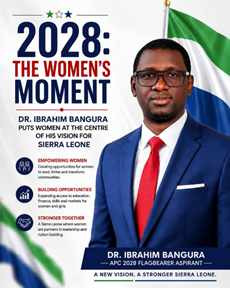
For Dr. Ibrahim Bangura, APC 2028 Flagbearer Aspirant, the answer cannot exclude Sierra Leonean women. His emphasis on women reflects a broader proposition: a nation cannot fully unlock its potential when a substantial part of its human capital is still operating below its possibilities.
This is not simply a question of fairness. It is a question of national capacity.
SIERRA LEONE DOES NOT HAVE A WOMEN -CAPABILITY PROBLEM
Everywhere in Sierra Leone, women are already demonstrating capability.
The market woman turns limited resources into household income. The farmer contributes to food security. The teacher shapes the next generation. The nurse sustains lives. The entrepreneur creates economic activity. The professional keeps institutions functioning. The young graduate searches for an opportunity to convert years of education into productive work.
The evidence of women’s determination is therefore not difficult to find.
The harder question is why so much of that determination remains constrained by inadequate access to capital, skills, technology, markets, networks and decision-making power.
The challenge is not convincing Sierra Leonean women to work. They are already working. The challenge is building an economy and institutions capable of rewarding their work with greater opportunity, ownership and prosperity.
That is where the conversation must move.
FROM SURVIVAL TO ECONOMIC POWER
For thousands of women, entrepreneurship begins at a very small scale. A trading table, a farm, a food business, a tailoring enterprise or a home-based venture may represent both livelihood and ambition.
But entrepreneurship cannot thrive on determination alone.
Finance matters. Skills matter. Technology matters. Infrastructure matters. Markets matter. So does the ability to move from an informal activity into a sustainable enterprise.
This is why women’s economic empowerment should not be reduced to distributing assistance. The more transformative objective is to create pathways through which women can produce, expand, employ, own and compete.
There is an important distinction here.
Access is not the same as empowerment.
A woman may receive training without finding a market. She may obtain credit without having the infrastructure to grow. She may possess an excellent business idea without the networks needed to scale it.
Real empowerment occurs when opportunity becomes agency, agency becomes productivity, and productivity creates income, ownership and influence.
That is the standard a serious national development agenda should pursue.
THE GIRL TODAY IS THE NATION TOMORROW
The long-term test begins even earlier—with the girl child.
A girl growing up in Freetown, Bo, Kenema, Makeni, Port Loko, Kono, Kailahun, Kabala or any other community should not have to negotiate with geography before she can negotiate with her dreams.
Her circumstances should not determine the size of her ambition.
Education remains foundational, but the modern economy demands more: relevant skills, digital literacy, mentorship, innovation, confidence and pathways into productive employment.
Sierra Leone needs girls who can see themselves as doctors, engineers, scientists, teachers, farmers, entrepreneurs, technology professionals, administrators and national leaders.
The girl sitting in a classroom today is not merely preparing for tomorrow’s job market. She may be preparing to solve tomorrow’s national problems.
That is why investment in girls is not charity. It is investment in the country’s future human capital.
FROM REPRESENTATION TO DECISION-MAKING
Women must also have a meaningful voice where decisions are made.
Representation matters, but representation alone is not enough. The deeper question is whether women have the authority, competence and institutional space to influence decisions.
Women should not be valued principally for their numbers at political rallies or their mobilisation during election seasons. Their importance extends far beyond electoral arithmetic.
They are citizens, professionals, entrepreneurs, community leaders and potential policymakers.
Their experiences can enrich decisions on education, healthcare, agriculture, livelihoods, social protection, enterprise development and the wider economy.
The transition we should seek is therefore simple but profound:
from women being spoken about to women helping shape what is spoken about; from women being represented to women exercising meaningful influence.
That is the difference between symbolic inclusion and substantive participation.
WHY THIS MATTERS TO THE WHOLE COUNTRY
There is sometimes a temptation to treat women’s empowerment as a specialised issue, relevant primarily to women.
It is not.
When a woman builds a productive enterprise, the benefits can extend to employees, children and communities. When a girl receives quality education, the country gains human capital. When women enter professions and leadership, institutions gain talent. When women participate more fully in the economy, Sierra Leone expands its productive base.
The advancement of women is therefore not separate from national development. It is one of its instruments.
This is what makes Dr. Ibrahim Bangura’s emphasis worthy of serious attention.
The real promise is not simply to speak positively about women. It is to imagine a Sierra Leone in which the barriers between women’s capability and women’s opportunity are systematically reduced.
A DIFFERENT MEASURE OF PROGRESS
Ultimately, the success of any women-centred vision should be measured not by the elegance of its language, but by the changes experienced in ordinary lives.
Can the market woman grow her business?
Can the farmer access productive inputs and reliable markets?
Can the young entrepreneur obtain appropriate financing?
Can the graduate acquire skills that translate into opportunity?
Can the girl from a rural community compete with confidence for the same possibilities as a girl from the capital?
Can a capable woman aspire to political leadership without being treated merely as an electoral asset?
These are the questions that should define the seriousness of the national conversation.
2028: A MOMENT TO THINK BEYOND POLITICS.
The significance of 2028 should ultimately extend beyond the contest for political office.
It should challenge Sierra Leone to think about the country it wants to become—and the human potential it can no longer afford to leave underutilised.
Dr. Ibrahim Bangura’s emphasis on women presents one possible framework for that conversation: not women as beneficiaries waiting for progress, but women as participants, producers, leaders and co-creators of national transformation.
The objective is not to advance women at the expense of men.
It is to build a country where talent is not unnecessarily restricted by gender, circumstance or geography.
Because a nation does not become stronger by asking half of its potential to wait.
Sierra Leone’s women are already building families, businesses, communities and institutions.
The question for 2028 is whether the country will build the opportunities, systems and leadership environment worthy of their potential.
- IBRAHIM BANGURA
Empowering Women. Expanding Opportunity. Strengthening Sierra Leone.
HEAL. UNITE. BUILD.