By Mahmud Tim Kargbo
Wednesday, 10 June 2026
For decades, Sierra Leone has been described as a country of enormous potential. The phrase has appeared in development reports, investment forums, diplomatic speeches and economic assessments with remarkable consistency. It is intended as a compliment, yet it also contains an uncomfortable truth. Potential is valuable, but potential alone does not create jobs, build industries or improve living standards. Nations are ultimately judged not by what they could become, but by what they actually achieve. It is against this backdrop that the launch of the European Chamber of Commerce in Sierra Leone and the Third Sierra Leone-European Union Public-Private Dialogue deserve closer examination. Beneath the speeches, presentations and formalities lies a far more important national question: can Sierra Leone finally convert potential into prosperity?
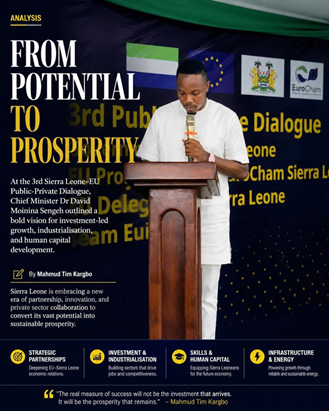
Representing President Julius Maada Bio at the event, Chief Minister, Dr David Moinina Sengeh, outlined a vision centred on investment, partnership and economic transformation. His remarks referenced developments across logistics, aviation, agriculture, manufacturing, mining, infrastructure and energy. On the surface, these appeared to be examples of progress taking place across different sectors of the economy. Yet viewed collectively, they revealed something much larger. They pointed towards an emerging development strategy designed to reposition Sierra Leone within the global economy. The speech was therefore not simply an update on investment activity. It was a statement about the country’s ambitions and the path it hopes to follow in the years ahead.
The significance of this moment lies in the fact that Sierra Leone appears increasingly determined to redefine the terms through which it engages with the world. For much of its post-war history, international engagement was shaped by conversations about recovery, reconstruction and development assistance. Those priorities were essential and helped restore stability after a devastating conflict. Yet recovery is not a permanent economic model. Every nation that aspires to sustainable prosperity must eventually transition from dependence on assistance to the creation of wealth through production, enterprise and investment. The growing emphasis on attracting capital, strengthening private sector participation and expanding industrial activity suggests that Sierra Leone is attempting to make precisely that transition.
This shift reflects broader changes taking place across Africa. Increasingly, governments are recognising that long-term development cannot depend solely on commodity exports, external assistance or public expenditure. Economic resilience requires productive industries, competitive businesses and strong private sector growth. The countries making the greatest strides in economic transformation are often those that succeed in attracting investment while simultaneously developing domestic capacity. Capital matters, but what matters even more is how that capital is used. The challenge is not simply bringing investment into a country. The challenge is ensuring that investment generates lasting value within it.
Europe occupies a particularly important place within this equation. The European Union remains one of the world’s largest sources of foreign direct investment and one of the most influential economic actors globally. Access to European markets can create opportunities for higher-value exports, while partnerships with European firms often bring technology, expertise and management practices that strengthen local industries. This helps explain why the establishment of a European Chamber of Commerce matters. Its significance extends beyond institutional symbolism. It represents an effort to deepen economic relationships capable of supporting long-term growth and greater integration into international markets.
One of the most revealing aspects of Dr Sengeh’s address was the range of examples he chose to highlight. African Global Logistics, Brussels Airlines, CFAO, agricultural exports, energy projects and infrastructure investments may appear unrelated at first glance. In reality, they form part of a larger economic picture. Logistics improve connectivity. Aviation strengthens access to markets. Skills development enhances competitiveness. Energy supports production. Infrastructure facilitates trade. Together, these elements constitute the foundations upon which modern economies are built. The speech was therefore less about individual projects than about the ecosystem required to sustain economic transformation.
The automotive training partnership involving CFAO provides an especially important insight into the development philosophy underpinning this approach. Economic growth is often measured through investment figures and infrastructure projects, yet the most successful economies understand that human capital remains their greatest asset. A nation can possess abundant natural resources and still struggle to achieve prosperity if its workforce lacks the skills required to compete in a rapidly changing global economy. Training institutions, technical education and workforce development therefore deserve to be viewed as strategic investments rather than social programmes. They determine whether economic opportunities are captured locally or imported from elsewhere. In that respect, the emphasis on skills transfer may prove as important as any physical infrastructure project currently underway.
The same logic applies to agriculture and manufacturing. For generations, many African economies have exported raw materials while importing finished goods. This model generates income, but it also limits the amount of value retained within national economies. When Sierra Leonean cocoa is transformed into premium chocolate sold in European markets, or when agricultural products undergo processing before export, a different economic dynamic begins to emerge. Value addition creates jobs, strengthens supply chains and expands opportunities for local enterprise. More importantly, it moves economies closer to production and away from dependence on raw commodity exports. This ambition was clearly evident throughout the Chief Minister’s remarks.
The mining sector presents an equally important test of this strategy. Sierra Leone’s deposits of iron ore, gold and lithium offer significant opportunities for economic growth. Yet history demonstrates that resource wealth alone does not guarantee development. Some of the world’s most resource-rich nations have struggled to translate natural assets into broad-based prosperity. The critical question is how resources are managed and how much value remains within the domestic economy. Discussions about beneficiation, local participation and value addition therefore carry considerable importance. They reflect a growing recognition that extraction alone is not enough. Sustainable prosperity requires economic activity that extends beyond the point of extraction.
Yet this is where the central tension emerges. Ambition is not the same as achievement. Across Africa and beyond, governments have announced industrialisation strategies, investment frameworks and economic transformation agendas that ultimately failed to deliver their intended outcomes. The difference between aspiration and success almost always comes down to execution. Sierra Leone’s challenge is therefore not simply attracting investors. It is creating the conditions that allow investment to translate into productivity, competitiveness and rising living standards. Investors may be attracted by opportunity, but citizens judge success through tangible improvements in their daily lives.
Energy illustrates this challenge more clearly than almost any other sector. Reliable electricity remains one of the most important prerequisites for industrial growth. Manufacturers require power. Processing facilities require power. Modern services require power. Without adequate energy infrastructure, economic transformation becomes significantly more difficult. The Chief Minister’s reference to major investments in power generation therefore deserves attention not because of the scale of the projects involved, but because of their strategic importance. Energy is not merely another sector of the economy. It is an enabler of virtually every other sector.
Equally important is the relationship between investment and public confidence. Development is not sustained by financial capital alone. It also depends upon trust. Citizens must believe that economic growth is creating opportunities for ordinary people rather than benefiting only a select few. Investors must believe that policies will remain predictable and institutions reliable. Communities must believe that development projects will generate meaningful benefits. This is why communication, transparency and public engagement remain essential components of economic transformation. Confidence is not a by-product of development. It is one of its most important foundations.
Perhaps the most important question raised by this moment concerns what success would actually look like. Success would not simply mean attracting larger volumes of investment capital. Nor would it be measured solely through infrastructure projects or economic growth statistics. True success would be reflected in stronger industries, higher productivity, greater export competitiveness and expanded employment opportunities. It would mean more Sierra Leoneans participating in value-added sectors of the economy. It would mean young people seeing opportunity at home rather than searching for it elsewhere. Above all, it would mean converting economic activity into broadly shared prosperity.
Ultimately, the launch of the European Chamber of Commerce may come to be remembered as more than a business event. It may symbolise a broader shift in national ambition. For generations, Sierra Leone’s greatest challenge has not been a lack of resources, talent or potential. It has been the difficulty of converting those assets into sustained prosperity. That is the challenge that remains before the country today. The partnerships celebrated during this dialogue will matter only if they strengthen industries, create opportunities and improve lives. The real measure of success will not be the investment that arrives. It will be the prosperity that remains.