By Mahmud Tim Kargbo
Few observations capture the contemporary realities of state building in Africa with greater clarity than this assertion. In fragile democracies emerging from histories of civil conflict, the professionalism of national security institutions is rarely a narrow administrative concern. It becomes a defining measure of state credibility itself.
For Sierra Leone, a nation whose post-war recovery has long depended upon institutional reconstruction, democratic consolidation, and international confidence, the evolution of the Sierra Leone Police carries significance extending far beyond conventional law enforcement.
It sits at the intersection of governance, stability, economic development, democratic legitimacy, and national peace building. It is within this broader geopolitical and institutional context that the tenure of Inspector General of Police William Fayia Sellu has increasingly attracted national, regional, and international attention.
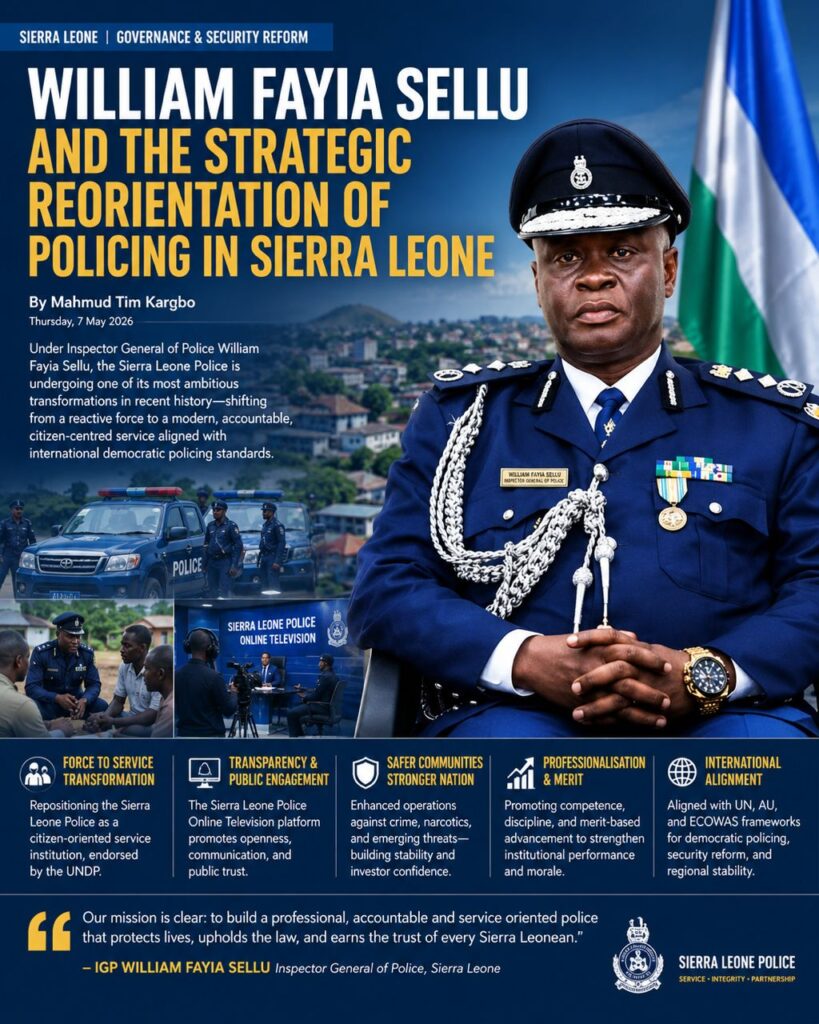
Since assuming office in July 2022 under the administration of President Julius Maada Bio, Sellu has overseen what many governance observers, security analysts, and institutional reform advocates regard as one of the most ambitious attempts in recent Sierra Leonean history to reposition the police from a traditionally reactive force into a modern, accountable, citizen centred public institution aligned with international democratic policing standards.
At the centre of Sellu’s leadership philosophy lies a clear recognition that the legitimacy of contemporary policing can no longer rest solely upon coercive authority or operational presence. In the twenty first century, effective policing is increasingly measured through transparency, professionalism, public trust, institutional accountability, technological adaptation, and the capacity of security institutions to function within democratic constitutional frameworks. That understanding represents a notable departure from several earlier periods in Sierra Leone’s policing history.
For decades, policing across much of West Africa, including Sierra Leone, was frequently characterised by rigid command structures, limited public engagement, weak communication systems, slow institutional adaptation, inconsistent accountability mechanisms, and operational cultures that were often more reactive than preventive. In many post-conflict societies, security institutions struggled to transition fully from force centred operational models towards democratic service oriented policing systems capable of commanding broad public trust.
Sellu’s administration has sought to confront precisely those structural weaknesses. The most emblematic reform introduced under his leadership has been the Force to Service initiative, a strategic institutional transformation programme designed to reposition the Sierra Leone Police as a citizen oriented service institution rather than a purely coercive security apparatus.
The significance of that reform extends far beyond rhetoric. The initiative reflects principles strongly aligned with the United Nations framework for democratic policing, the African Union Policy Framework on Security Sector Reform, ECOWAS conflict prevention standards, and broader international governance expectations concerning accountability within security institutions.
The United Nations Development Programme has openly endorsed the reform trajectory, describing it as a transformative effort centred on professionalism, public trust, accountability, legal modernisation, and community engagement.
https://www.undp.org/sierra-leone/news/force-service-how-undp-supporting-police-transition-sierra-leone That endorsement carries considerable weight.
In contemporary governance analysis, international institutions increasingly assess state legitimacy not only through electoral processes but also through the operational behaviour of security institutions. Policing standards have become central indicators of democratic maturity, institutional stability, governance reliability, and investment confidence.
Sellu appears acutely aware of this evolving global reality. Under his stewardship, the Sierra Leone Police has expanded community policing structures, strengthened stakeholder engagement mechanisms, promoted dialogue based policing strategies, and increased direct interaction between law enforcement authorities and local communities.
This approach reflects a broader understanding increasingly accepted within international security studies that sustainable security cannot be imposed solely through enforcement power. It must also be built through consent, legitimacy, and social trust.
In Sierra Leone’s context, that distinction carries profound importance. The country’s civil war left deep institutional scars, including long standing public sensitivities regarding state authority, security force conduct, political stability, and institutional credibility. Rebuilding confidence in public institutions therefore remains inseparable from the broader project of democratic consolidation.
Under previous policing eras, public confidence in law enforcement was frequently undermined by accusations of opacity, political vulnerability, delayed communication, operational inconsistency, and weak accountability structures. While institutional challenges have by no means disappeared under Sellu’s administration, the direction of reform nonetheless reflects a measurable attempt to reshape both operational culture and public perception.
One of the clearest manifestations of this institutional repositioning has been the launch of the Sierra Leone Police Online Television platform. At first glance, the initiative may appear administrative or informational. In reality, it represents a strategic communication reform with significant democratic implications.
Across large parts of Africa, one enduring institutional weakness within policing systems has been the absence of proactive public communication. Security institutions have historically communicated reactively, often only during crises, leaving informational vacuums filled by rumour, political manipulation, misinformation, or public suspicion.
Sellu’s administration has attempted to reverse that pattern. The Sierra Leone Police Online Television platform provides public briefings, operational updates, civic education programming, crime awareness discussions, security advisories, and direct institutional communication accessible both domestically and internationally.
In modern democratic policing theory, visibility itself constitutes a form of institutional accountability. Citizens are more likely to trust institutions willing to explain their operations, communicate openly, and engage public scrutiny. By embracing digital communication infrastructure, the Sierra Leone Police under Sellu signals an understanding that institutional legitimacy in the digital age depends increasingly upon transparency and accessibility rather than bureaucratic distance.
The reform also aligns closely with contemporary United Nations and African Union governance principles regarding accountable security sector management and citizen engagement. Importantly, this communication strategy carries implications extending beyond domestic public relations. International investors, diplomatic actors, and development partners increasingly evaluate governance environments through institutional behaviour, transparency standards, and crisis communication capacity.
Modern policing visibility therefore contributes indirectly to broader economic confidence and international perception. This is especially relevant in developing economies seeking foreign direct investment. Investors are rarely influenced solely by macroeconomic projections. They also assess political stability, security reliability, crime management capability, institutional predictability, and the professionalism of state structures responsible for maintaining public order.
Under Sellu’s administration, the Sierra Leone Police has increasingly framed security not merely as a law enforcement issue but as a foundational component of national development architecture. That philosophy is visible in the administration’s emphasis on crime prevention, operational responsiveness, intelligence coordination, anti narcotics operations, cybercrime awareness, election security preparedness, crowd control reforms, youth safety campaigns, public order management, and technological modernisation initiatives including expanded CCTV surveillance deployment within Freetown.
The Sierra Leone Police has also intensified operations targeting narcotics distribution networks and the growing Kush crisis that has emerged as a major social and public health concern among Sierra Leonean youth. Through coordinated enforcement campaigns, public awareness engagement, intelligence based operations, and inter agency collaboration, the institution has increasingly positioned itself not merely as a reactive force but as a stabilising national security actor confronting evolving social threats before they escalate into wider instability. https://afriqueurope.net/?p=3731
These reforms reflect international trends within urban security governance, where technological integration, intelligence driven policing, surveillance coordination, operational responsiveness, and preventive security strategies increasingly define modern law enforcement systems.
Their importance for Sierra Leone is substantial. In post-conflict states, visible improvements in public security often function as early indicators of institutional recovery and state resilience. Reduced criminality, stronger operational responsiveness, improved public order management, and greater policing credibility help create conditions favourable to commerce, tourism, foreign investment, and broader economic activity.
Security stability, in this sense, becomes economic infrastructure. Sellu’s tenure has also demonstrated a notable emphasis on professionalisation within the police hierarchy itself. Promotions and leadership advancement under his administration have repeatedly been framed within the principles of competence, discipline, institutional performance, and professional merit. https://www.africa-press.net/sierra-leone/all-news/igp-fayia-sellu-decorates-25-newly-promoted-superior-police-officers This may appear procedural, yet its institutional implications are significant. Across numerous developing states, security institutions have historically struggled with patronage systems, political dependency, morale deficits, and uneven professional standards. Merit based advancement structures strengthen operational discipline, institutional confidence, and organisational cohesion.
Sellu’s own international policing and peacekeeping experience has also shaped the broader orientation of his leadership. Having served within United Nations peacekeeping missions including operations in Darfur, he represents a generation of African security leadership increasingly exposed to transnational policing frameworks, international operational standards, and multilateral security cooperation structures. https://www.police.gov.sl/uncategorized/igp-fayia-sellu-welcomes-home-fpu-4-contingent/ That experience carries strategic importance. Peacekeeping exposure often accelerates institutional learning in areas such as human rights compliance, crowd management, civilian protection standards, crisis de escalation, international interoperability, and regional security coordination.It also strengthens diplomatic credibility within regional and global security networks.
Indeed, Sierra Leone’s evolving policing profile under Sellu increasingly mirrors broader continental efforts to modernise African security governance. The African Union Security Sector Reform framework has repeatedly emphasised that professional, accountable, and democratically governed security institutions are essential prerequisites for sustainable peace and development across the continent. https://au.int/en/documents/20140131/policy-framework-security-sector-reform-ssr
Similarly, ECOWAS conflict prevention protocols continue to stress the importance of citizen centred security governance in maintaining regional stability and democratic resilience. https://www.ecowas.int/ecowas-conflict-prevention-framework-ecpf/ The Sierra Leone Police reforms therefore exist not in isolation but within a wider continental movement towards democratic security institutionalism.
Naturally, challenges remain. Resource limitations, infrastructural pressures, uneven public confidence, logistical constraints, evolving criminal networks, and broader governance vulnerabilities continue to test the capacity of Sierra Leone’s security architecture. No serious institutional analysis would suggest that the reform process is complete.
Yet leadership trajectories matter. Under William Fayia Sellu, the trajectory of the Sierra Leone Police increasingly points towards modernisation, professionalisation, technological adaptation, public engagement, democratic accountability, and internationally aligned policing standards. That distinction is important not merely administratively but historically.
In societies emerging from conflict, the transformation of policing institutions often becomes one of the clearest visible indicators of whether democratic state building is genuinely taking root.
For Sierra Leone, the implications extend far beyond police reform alone. They speak to the broader question of what kind of state Sierra Leone seeks to become in the decades ahead, whether governed through fear and institutional opacity, or strengthened through legitimacy, accountability, professionalism, and democratic public trust.
In many respects, William Fayia Sellu’s tenure represents an attempt to answer that question through institutional action rather than political rhetoric. Whether every reform ultimately achieves its intended outcome will be judged by history. At this stage, however, one conclusion appears increasingly difficult to dispute. In countries emerging from histories of fragility, institutions matter more than slogans.
In Sierra Leone’s evolving democratic journey, the reform trajectory of the Sierra Leone Police under William Fayia Sellu may ultimately be remembered not simply as a policing transition, but as part of the broader struggle to redefine the relationship between the state, the citizen, and the future of democratic governance itself.