By ABSAS
In politics, the strongest leaders are not those who merely compete for power, but those who demonstrate the maturity to place unity above ambition. Such a moment unfolded at Masjid Rahman on Bombay Street, where Dr. Ibrahim Bangura and Hon. Joseph Fitzgerald Kamara (JFK), both aspiring to lead the All People’s Congress (APC), stood shoulder to shoulder in prayer, sending a powerful message to party members and the nation.
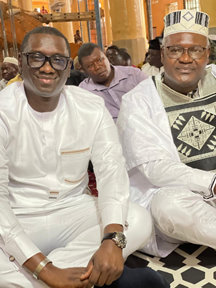
The joint prayer gathering, hosted by the United Communities of Muslims of the Bashirian Mission, was more than a religious observance. It was a symbolic declaration that faith, fraternity, and national responsibility must remain stronger than political rivalry. At a time when many citizens are yearning for reconciliation and hope, the sight of leading APC figures worshipping together offered a refreshing example of constructive engagement and mutual respect.
Addressing the congregation, Dr. Ibrahim Bangura reflected on his longstanding relationship with the Bashirian Mission. He noted that his father was among the founding members of the movement established by the late spiritual leader, Fadilatu Sheikh Imam Bashir Sankoh-Yillah. Describing himself as a son of the institution, Dr. Bangura reaffirmed his enduring commitment to supporting the Mission’s development initiatives, including the refurbishment of Masjid Rahman.
Dr. Bangura explained that Hon. Joseph Fitzgerald Kamara had personally invited him to join the Jumah prayers. He welcomed the invitation as a meaningful gesture that transcended politics and reinforced the need for unity within the APC and across Sierra Leone. According to him, the country’s future depends on healing old divisions, strengthening communities, and building a society where every citizen can share in progress and opportunity.
In his remarks, Hon. Joseph Fitzgerald Kamara emphasized that political competition should never become a source of division. He praised Dr. Bangura for responding positively to the invitation despite both men seeking the APC flagbearer position. The gathering, he said, demonstrated that party unity remains a shared responsibility. He further pledged to continue engaging fellow aspirants in a spirit of mutual respect as the APC prepares for 2028.
The event also highlighted a culture of service. Mr. Dura Conteh, a strategic leader within the JFK Movement, presented a donation toward the mosque’s development, reinforcing a tradition of community support that Dr. Bangura has consistently championed. Such gestures remind Sierra Leoneans that leadership is ultimately measured by service rather than slogans.
The congregation responded enthusiastically, expressing appreciation for the humility and solidarity displayed by the two leaders. Their presence among worshippers was widely viewed as evidence that meaningful reconciliation is possible when leaders choose dialogue over division and cooperation over confrontation.
Yet the significance of the day extended beyond politics. Dr. Bangura paid his final respects to the late APC heroine and Ward 422 Chairlady, Comrade Adama Fullah. Offering condolences to her family, he prayed that Allah grant her Al-Jannah Firdaus and comfort all who mourn her passing.
The day’s engagements concluded with a visit to newly returned Hajjah F.A. Rahman at Kissy Road, where prayers were offered for her family, the Fourah Bay community, and the nation at large. Fresh from the holy pilgrimage to Makkah, the gathering became another opportunity to invoke Allah’s blessings upon Sierra Leone.
Taken together, these events reveal a deeper lesson. Nations are not transformed solely by elections, speeches, or manifestos. They are transformed when leaders demonstrate humility, respect, faith, and a genuine commitment to the common good. The image of rival aspirants praying together, supporting community development, honoring the departed, and seeking blessings for the nation is one that resonates far beyond the walls of a mosque.
In an era often defined by political polarization, this gathering offered something different: a vision of leadership anchored in unity, service, and national renewal. For many who witnessed it, the message was unmistakable—Sierra Leone’s future will be strongest when its leaders choose to heal divisions, unite communities, and build a nation where every citizen has a reason to believe that better days lie ahead.