By Mahmud Tim Kargbo
New York became a working ground for Sierra Leonean interests on Friday, as Minister of Employment, Labour and Social Security Hon Umaru Napoleon Koroma carried a domestic agenda into a succession of high level engagements on workers, migration, international law and development finance. What connected them was policy. The protection of seafarers, migrant workers, legal representation and development finance all return to one national question: whether international engagement can produce greater security and opportunity at home. That is where diplomacy becomes more than presence.
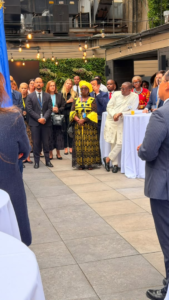
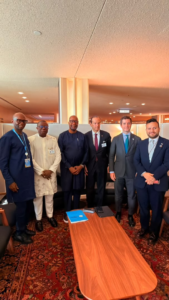
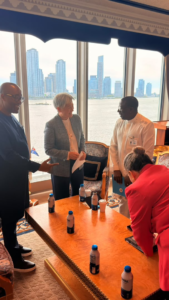
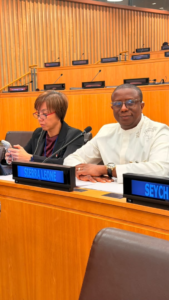
The day opened with discussions on the protection of the sea and seafarers, an issue with particular relevance to a maritime country. The International Maritime Organisation (https://www.imo.org/) has made “From Policy to Practice: Powering Maritime Excellence” its World Maritime Day theme for 2026 and 2027, stressing that international rules must be translated into national legislation, enforcement, training and practical protection. (International Maritime Organisation) For Sierra Leone, the implication is direct: maritime standards matter most when they reach the worker on deck, not merely the diplomat at the conference table. The employment agenda therefore begins with turning international obligations into everyday protection.
That principle carried into Koroma’s meeting with the Director of the International Organisation for Migration (https://www.iom.int/), concerning the organisation’s country plan and possible support for Sierra Leone in addressing regular and irregular labour migration. The supplied account places safe migration pathways, protection from exploitation and fraudulent recruitment, and the developmental value of migration at the centre of the engagement. These are not peripheral questions for a country whose citizens seek opportunity beyond its borders. Migration can strengthen households through remittances and skills, but those gains weaken when workers encounter deception, abuse or unsafe routes. Labour policy must therefore protect mobility without allowing the search for work to become a licence for exploitation.
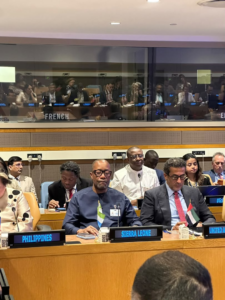
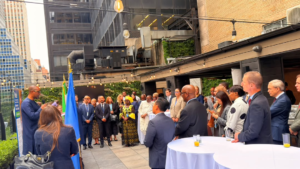
The bilateral meetings with the Foreign Ministers of Panama and Australia carried the agenda into international law, including Sierra Leone’s support for Professor Charles Chernor Jalloh’s candidature for the International Court of Justice (https://www.icj-cij.org/) for the 2027 to 2036 term. United Nations documentation records the candidature and the forthcoming November 2026 election. (United Nations Office of Legal Affairs) The immediate campaign matters, but the deeper issue is continuity. A smaller State cannot manufacture legal influence by appearance; it must accumulate expertise, credibility and relationships. Legal competence becomes diplomatic capital when it is sustained within institutions that shape international rules.
There is evidence for that institutional depth. The United Nations International Law Commission (https://legal.un.org/ilc/) lists Jalloh among its members for the 2023 to 2027 quinquennium, and its 2026 session records him as Chair of the Working Group on Methods of Work and Procedures. (United Nations Office of Legal Affairs) The Commission is responsible for work on the progressive development and codification of international law. His continuing role places Sierra Leonean expertise inside that process. Durable influence is built before the vote, through professional standing that survives the political calendar.
The economic dimension was equally consequential. At the 50th Annual Meeting of Ministers for Foreign Affairs of the Group of 77 and China (https://www.g77.org/), Sierra Leone raised debt cancellation, reform of the international financial architecture, improved access to Special Drawing Rights and a fairer global tax system. The United Nations schedule confirms that the ministerial meeting opened in New York on 25 September 2026. (United Nations Office of Legal Affairs) Fiscal space determines how much governments can invest in infrastructure, enterprise, skills and public services. How a country finances development therefore shapes how its citizens find work.
Together, the engagements form a more coherent picture than an itinerary suggests. Seafarer protection concerns the quality of work; labour migration concerns the movement and rights of workers; international legal representation concerns the rules within which States operate; and financial reform concerns the resources available to pursue development. They are separate diplomatic files, but converge on the same national interest. Sierra Leone’s challenge is to make those strands reinforce one another. Diplomacy earns greater value when its external relationships enlarge domestic policy choices.
The meetings with Panama and Australia, the luncheon for Jalloh’s candidature and participation in the Joint Arab Islamic Ministerial Meeting on Jerusalem broadened the diplomatic field. For a smaller State, such engagements create relationships that can become useful across different questions. Yet meetings alone are not strategic success. The consequential question is what follows them: technical cooperation, institutional support, stronger representation, safer migration channels or greater room to finance development. The diplomatic calendar matters when something from it travels home.
That is also why Sierra Leone’s legal participation deserves a longer horizon. International representation gives the country opportunities to contribute to rules affecting trade, migration, labour, development and the conduct of States. It is strategic capital that can strengthen the credibility with which a country negotiates. The same applies to labour and migration diplomacy: standards become valuable when national institutions can implement them. Influence abroad and capacity at home are therefore part of the same equation.
The significance of Koroma’s programme lies in that connection. The seafarer, migrant worker, international lawyer and government seeking fiscal space occupy different policy worlds, but share one national question: how to secure greater room for Sierra Leoneans to work, move and prosper. Foreign policy becomes meaningful when it affects those possibilities. The test is how effectively visibility becomes protection, opportunity and institutional influence.
The meetings end. The work begins.
For Sierra Leone, the real measure will be what survives after the meetings disappear from the diplomatic calendar: safer work, better managed migration, credible legal representation and greater capacity to finance development. That is the point at which international diplomacy stops being an itinerary and becomes public policy. A country may enter the world’s rooms as a small State, but it need not leave them without leverage. The distance between New York and Sierra Leone is ultimately measured not in miles, but in what diplomacy manages to bring home.