-National Environment and Safeguard Specialist at FAO
By Kadiatu Sankoh
The National Environment and Safeguard Specialist at the Food and Agricultural Office in Sierra Leone, Musa Septimus Koroma has said the country’s forest cover has significantly declined over the years due largely to agricultural expansion, logging, mining, infrastructure development, population growth, and weak policy enforcement.
Koroma made this statement on Tuesday 17th February this year during a one-day sensitization and engagement meeting for members of the National Network of Civil Society Organisations (CSOs) held at the CHASL Conference Room, Kingharman Road, Freetown.
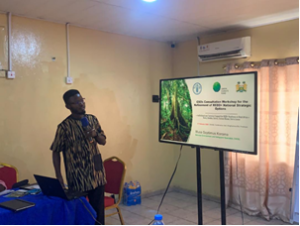
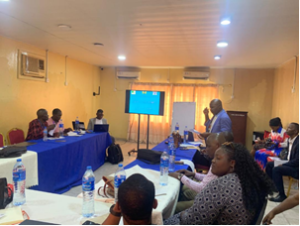
The event which was organized by the Conservation Society of Sierra Leone (CSSL) focused on forest protection in conserving the environment.
Welcoming participants, Edward Momoh Sesay, Head of Programs at CSSL, expressed appreciation to all stakeholders for attending and underscored the urgency of conservation.
“We need to conserve. How do we survive if we do not conserve? Many people do not even understand what conservation means. Conservation allows resources to continue to exist and support us. If we fail to conserve, we are heading toward destruction, not development,” he said.
He warned that unchecked exploitation of natural resources would benefit only a few, leaving the majority vulnerable. “If only a few people control these resources, the greater masses will be left with nothing. Disasters will come, and they will affect everybody. This is what we want to stop,” he stated.
The Communications Manager of CSSL, Abdul Dumbuya, outlined the objectives of the meeting. He emphasized the importance of preserving forests and ensuring sustainable harvesting practices.
“We are here for two reasons,” he said. “First, to raise awareness among members of the National Network of CSOs about the REDD+ process. Second, to equip you with the knowledge needed to effectively communicate and promote REDD+ initiatives.”
He explained that REDD+ has three phases: Readiness, Implementation and Demonstration, and Results-Based Payments. He also informed participants that the meeting would conclude with the election of the governance body of the National Network of CSOs on REDD+.
Delivering a keynote update, Dr. Gbessay Momoh thanked ministers, colleagues, partners, and technical committee members for their continued commitment to the national REDD+ process. He reported that approximately 90 percent of key outputs under the REDD+ framework have been completed.
Over the past two years, three credible technical reports have been produced with support from consultants and technical experts. These reports were reviewed at ministerial level and acknowledged for their quality and progress.
Dr. Momoh highlighted the establishment of a multi-layered national REDD+ structure, including a Steering Committee, Technical Committee, National REDD+ Technical Committee, various subcommittees, the REDD+ Coordinating Office (PMU), and a National REDD+ Multi-Stakeholder Technical Platform.
He noted that while these structures have been validated, full operationalization remains critical. For instance, the Measurement, Reporting, and Verification (MRV) Unit has been established, but is not yet fully functional. He emphasized that government endorsement, dedicated personnel, budget allocation, and integration into national systems are required to make it fully operational.
He further explained that most capacity-building activities have been completed, with only one additional MRV training pending. The Food and Agriculture Organization (FAO) continues to support the process.
Dr. Momoh stated that of the four required REDD+ pillars, two have been fully completed. The remaining pillars—Safeguards Information System (SIS) and Forest Reference Emission Level (FREL)—are in progress. He noted that data from the ongoing National Forest Inventory will strengthen the country’s ability to determine carbon emission baselines accurately.
He concluded by stressing that REDD+ must transition from project-based support to a nationally embedded system backed by strong government ownership, staffing, and sustainable funding.
Also presenting at the meeting was Musa Septimus Koroma, National Environment and Safeguard Specialist at FAO Sierra Leone. He outlined the guiding principles for REDD+ implementation and clarified that REDD+ stands for “Reducing Emissions from Deforestation and Forest Degradation,” including conservation, sustainable management of forests, and enhancement of forest carbon stocks. He noted that the initiative operates under the United Nations Framework Convention on Climate Change (UNFCCC).
Koroma highlighted alarming statistics on forest loss in Sierra Leone, pointing out that forest cover has significantly declined over the years due largely to agricultural expansion, logging, mining, infrastructure development, population growth, and weak policy enforcement.
He explained that consultations and field assessments were conducted nationwide to identify both direct and underlying causes of deforestation. Poverty, land tenure issues, slash-and-burn agriculture, firewood extraction, and extractive industries were identified as key drivers.
To address these challenges, new strategic options for 2025 have been proposed. These include promoting sustainable agriculture and agroforestry, strengthening forest protection and law enforcement, regulating timber markets, rehabilitating degraded lands, supporting alternative livelihoods, and leveraging carbon credit opportunities.
Koroma emphasized that the REDD+ strategy is built on inclusive consultations involving ministries, departments, agencies, civil society networks, and community stakeholders.
The meeting concluded with the election of the governance body of the National Network of Civil Society Organizations (CSOs) on REDD+. The newly elected body is expected to provide leadership, coordination, and strategic direction to strengthen civil society participation in the national REDD+ process.
Participants expressed optimism that the new leadership will enhance collaboration among stakeholders and ensure that civil society continues to play an active role in promoting sustainable forest management and climate action across Sierra Leone.