House Deputy Speaker Calls for National Reconciliation
Deputy Speaker of Parliament, Hon. Ibrahim Tawa Conteh, delivered a passionate and reflective address in support of a private motion moved by the Leader of Government Business and seconded by the Opposition Leader, Hon. Abdul Kargbo, seeking Parliament’s endorsement of the State’s decision to discontinue all criminal proceedings against former President Dr. Ernest Bai Koroma.
Describing the day as a defining moment in Sierra Leone’s democratic journey, Hon. Conteh anchored his remarks on the enduring values of forgiveness, reconciliation and national cohesion. He began by invoking the biblical principle that “to err is human, to forgive is divine,” stressing that forgiveness remains one of the greatest virtues that can unite a divided nation.
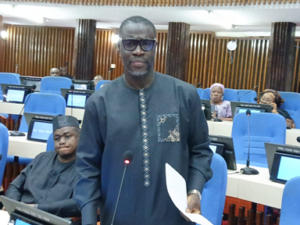
The Deputy Speaker noted that the Sixth Parliament of the Second Republic had been presented with a historic opportunity to strengthen national unity and leave behind a legacy of peace for future generations. Reflecting on his own journey from Tonko Limba in Kambia District to serving as Deputy Speaker under the leadership of the Speaker of Parliament, Rt. Hon. Segepoh Solomon Thomas, he said Parliament must always rise above political differences whenever the peace and stability of the nation are at stake.
Hon. Conteh commended the Attorney-General and Minister of Justice for providing the legal basis upon which the State discontinued the proceedings, explaining that the decision was firmly rooted in both the Constitution and the Criminal Procedure Act. According to him, the President of the Republic, under Section 40 of the Constitution, is not only the Fountain of Honour, but also the Guardian of Peace and Security, entrusted with preserving national stability.
He praised President Julius Maada Bio for demonstrating exceptional statesmanship throughout Sierra Leone’s political history. Recounting President Bio’s role during the country’s civil conflict, the Deputy Speaker recalled that despite the immense suffering he personally experienced during the war, President Bio chose the path of peace over revenge.
He reminded Parliament that President Bio accepted the people’s desire for democratic elections in 1996, even before the war had fully ended, because he believed that leaders must always listen to the voice of the people. Quoting the Latin maxim “Vox Populi, Vox Dei” (“the voice of the people is the voice of God”), Hon. Conteh said true leadership demands humility and responsiveness to the aspirations of citizens.
The Deputy Speaker further observed that after conducting the landmark elections, President Bio voluntarily relinquished power and later returned to Sierra Leone as a civilian, demonstrating an unwavering commitment to democracy and constitutional governance.
Reflecting on President Bio’s political journey within the Sierra Leone People’s Party (SLPP), Hon. Conteh recounted how he personally witnessed the President’s determination during the party’s leadership contests in the mid-2000s. Despite facing setbacks, President Bio remained committed to the democratic process and eventually emerged as the party’s leader through perseverance rather than division.
Turning to Parliament’s constitutional mandate, Hon. Conteh reminded Members that Section 73 of the Constitution empowers Parliament to make laws for the peace, security and good governance of Sierra Leone. He therefore argued that the resolution before the House was fully consistent with Parliament’s responsibility to promote national harmony.
According to him, Parliament was not merely debating a legal matter, but laying the foundation for lasting peace and reconciliation. He maintained that the discontinuance of the proceedings against former President Koroma was neither unconstitutional nor politically motivated, but represented an important step toward healing national divisions.
The Deputy Speaker also highlighted President Bio’s current role as Chairman of the ECOWAS Authority of Heads of State and Government, emphasizing that effective regional leadership begins with peace at home. He noted that Sierra Leone cannot credibly champion peace across West Africa while remaining divided internally.
“Charity begins at home,” he declared, urging Sierra Leoneans to embrace reconciliation as a national responsibility rather than a partisan exercise.
Hon. Conteh praised the spirit of bipartisan cooperation demonstrated by both the Government and Opposition leadership in bringing the motion before Parliament. He commended the Opposition Leader, Hon. Abdul Kargbo, for placing national interest above political considerations and described the day’s proceedings as evidence that Parliament can unite whenever the country’s future is at stake.
Addressing the issue of political intolerance, the Deputy Speaker lamented the increasing tendency for political affiliation to divide families, neighbours and communities. He observed that many Sierra Leoneans who live peacefully together suddenly become adversaries during election periods simply because they belong to different political parties.
He called on citizens to reject discrimination based on political identity, insisting that Sierra Leone remains one nation regardless of party colours. Using practical examples from everyday life, he illustrated how family members often belong to different political parties or profess different religions while continuing to coexist peacefully.
Sharing a personal example, Hon. Conteh revealed that he is a Muslim while his wife is a Christian, emphasizing that religious differences have never prevented mutual respect within his family. Likewise, he said political affiliation should never become a source of hatred or division among Sierra Leoneans.
He further argued that former Presidents should be regarded as national statesmen rather than partisan actors. In his view, former Heads of State possess valuable experience that should remain available to leaders of every political party seeking advice on matters of national importance.
The Deputy Speaker warned politicians against creating unnecessary fear among their supporters whenever they engage with members of opposing political parties. He maintained that dialogue, consultation and mutual respect strengthen democracy rather than weaken it.
Calling on the media to play a constructive role, Hon. Conteh urged journalists to highlight the positive message of peace contained in the parliamentary resolution instead of promoting sensational political divisions. He described the media as the Fourth Estate with a critical responsibility to advance national unity through balanced and responsible reporting.
Hon. Conteh also paid glowing tribute to the Leader of Government Business, describing him as the principal architect behind the parliamentary diplomacy that ultimately facilitated dialogue between President Julius Maada Bio and former President Ernest Bai Koroma. He praised the Leader of Government Business for introducing the concept of parliamentary diplomacy as an effective tool for conflict resolution and national reconciliation.
According to the Deputy Speaker, the document before Parliament stands as the product of months of sincere engagement and dialogue, and future generations will remember the Sixth Parliament for choosing peace over confrontation.
Quoting lessons from his school days, Hon. Conteh recalled the literary themes “Building the Nation” and “Mending the World,” saying those ideals perfectly reflected Parliament’s responsibility at this historic moment.
He concluded by expressing confidence that the resolution would become a landmark achievement in Sierra Leone’s democratic history, and urged all citizens to support efforts aimed at strengthening national cohesion, peaceful coexistence and democratic stability.
“As we build the nation today,” he concluded, “future generations will remember that this Parliament chose reconciliation over division, peace over conflict, and national unity over partisan interests.”
The Deputy Speaker thanked the Speaker of Parliament for the opportunity to contribute to what he described as one of the most significant debates of the Sixth Parliament of the Second Republic.