By Mariama Bah
The Executive Chairman of the Produce Monitoring Board (PMB) of Sierra Leone, Raymond Bob-Katta, has challenged global coffee leaders to treat nature as a measurable economic asset, not charity.
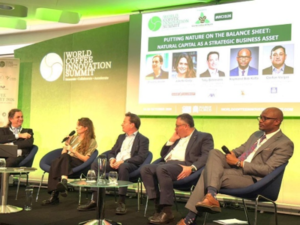
He made the call in London on 21-22 October 2026 while addressing the World Coffee Alliance panel on “Putting Nature on the Balance Sheet: Natural Capital as a Strategic Business Asset” at the World Coffee Innovation Summit.
Speaking alongside European commodity-finance leaders, global roasters and development finance institutions, Chairman Bob-Katta said the global commodity market has failed to correctly price nature.
“We discuss a US$3-4 billion smallholder-finance gap within a US$19 trillion global commodity-derivatives market that prices weather, freight and volatility to the second decimal place – yet prices nature at zero until it collapses,” he said. “Putting nature on the balance sheet is not ESG. It is risk pricing.”
The PMB Chairman introduced what he called the “Bean-to-Biome Thesis,” arguing that traceability must go beyond bean-to-cup to bean-to-biome accountability.
“A forest is not CSR. Soil organic matter is not charity. Biodiversity in the Kasewe and Kambui Hills is not merely a story. These are productive assets,” he noted.
He said PMB has mapped over 12,000 registered smallholders with production histories and is building ISO-compliant systems to make them visible and bankable through verifiable identity, interoperable data and quality infrastructure.
Aligning his argument with President Julius Maada Bio’s Big Five Agenda and Feed Salone Programme, he stressed: “Quality is not a hurdle imposed from outside. It is sovereignty exercised from within. You cannot retain value you cannot verify.”
He outlined PMB’s three-pronged model to connect finance to farmers: de-risked aggregation, digital collateral through georeferenced farms, and resilience-priced offtake.
“Capital does not lack liquidity. It lacks capillaries,” he said.
His central message: “Do not ask how to include Africa in the value chain. Ask how to price Africa’s contribution to the survival of that chain.”