By Fadda Bakish
The Government of Sierra Leone has reaffirmed its commitment to protecting consumers from the impact of rising global petroleum prices by maintaining fuel subsidies that will keep pump prices below prevailing international market rates, the National Petroleum Regulatory Authority (NPRA) has announced.
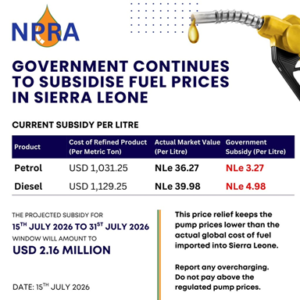
According to the Agency, the projected government subsidy for the period 15 July to 31 July 2026 is expected to amount to approximately US$2.16 million, enabling motorists and businesses to continue purchasing fuel at regulated prices despite increases in the international cost of refined petroleum products.
The announcement underscores government’s determination to cushion Sierra Leoneans against escalating fuel costs while sustaining economic activity and easing transportation expenses across the country.
NPRA disclosed that the current international cost of imported petroleum products would ordinarily require significantly higher pump prices, were it not for government intervention.
For petrol, the cost of the refined product stands at US$1,031.25 per metric ton, translating into an actual market value of NLe36.27 per litre. However, Government is subsidising NLe3.27 per litre, allowing consumers to continue purchasing petrol at the regulated pump price of NLe33.00 per litre.
Similarly, for diesel, the refined product currently costs US$1,129.25 per metric ton, with an actual market value of NLe39.98 per litre. Government is absorbing NLe4.98 per litre, thereby maintaining the official retail price of NLe35.00 per litre.
“This price relief keeps the pump prices lower than the actual global cost of fuel imported into Sierra Leone,” NPRA stated, adding that the subsidy demonstrates government’s continued commitment to shielding citizens from volatile international oil markets.
The Agency also reminded the public that no filling station is permitted to charge above the approved prices of NLe33 per litre for petrol and NLe35 per litre for diesel.
“Members of the public should report any overcharging and should not pay above the regulated pump prices,” the Agency emphasized, encouraging consumers to remain vigilant and cooperate with regulators in protecting their rights.
The latest subsidy announcement comes amid a broader programme of reforms being spearheaded by the National Petroleum Regulatory Authority under the leadership of Director General Brima M. Baluwa Koroma, who assumed office in early July 2025.
Since taking over the Agency, Mr. Baluwa Koroma has embarked on an ambitious transformation agenda aimed at modernising Sierra Leone’s downstream petroleum industry through enhanced regulation, increased transparency and strategic investment.
“We are opening up the market space and restoring fairness in the industry for all players, which will increase sector efficiency and transparency,” the Director General said, describing the guiding philosophy behind the Agency’s ongoing reforms.
Industry observers note that one of NPRA’s most significant achievements has been the strengthening of regulatory oversight through intensified nationwide inspections of petroleum filling stations.
These inspections are designed to ensure strict compliance with quality, safety and measurement standards, while protecting consumers from adulterated petroleum products, under-dispensing pumps and other unfair commercial practices.
The Agency has also introduced a strengthened public complaints mechanism that allows consumers to confidentially report cases of fuel adulteration, pump manipulation and other violations.
Officials say the initiative is intended to empower consumers while enhancing accountability throughout the petroleum distribution chain.
Recognising the importance of collaboration, NPRA has further institutionalised regular consultations with oil marketing companies, petroleum dealers and transport unions.
According to the Agency, these engagements provide an important platform for dialogue on pricing, supply challenges and regulatory improvements, helping to strike a balance between protecting consumers and maintaining a commercially viable petroleum industry.
Public safety has also become a major pillar of the Agency’s reform agenda.
NPRA has expanded nationwide public sensitisation campaigns on the safe handling, transportation and storage of petroleum products, with the objective of reducing fire incidents, environmental hazards and other risks associated with petroleum operations.
Looking beyond regulation, the Agency is actively encouraging investment in critical petroleum infrastructure that could strengthen Sierra Leone’s long-term energy security.
“We are encouraging investors to look at the possibility of resuscitating our oil refinery, constructing tank farms across the regions, bulk transportation, and retailing,” Mr. Baluwa Koroma explained.
He noted that expanding petroleum infrastructure would reduce supply disruptions, improve storage capacity, lower operational costs and generate employment opportunities while strengthening national energy resilience.
The Director General also reaffirmed NPRA’s commitment to enforcing petroleum legislation and ensuring full compliance with licensing and tax obligations.
He stressed that transparency, professionalism and predictable regulation remain fundamental to attracting both domestic and international investment into Sierra Leone’s downstream petroleum sector.
The Agency’s reform programme is further reinforced through its engagement with international petroleum institutions, including the World Petroleum Council (WPC) and the Africa Refiners Association (ARA), enabling Sierra Leone to benefit from global best practices, technical expertise and industry partnerships.
As part of its modernization drive, NPRA is also preparing to introduce a digital petroleum product tracking system that will improve supply chain monitoring, strengthen traceability, reduce fraud and enhance operational efficiency throughout the sector.
Plans are equally underway to expand the Agency’s regional presence by establishing additional offices across the country, bringing regulatory services closer to petroleum operators and consumers alike.
Industry stakeholders have welcomed the reforms introduced under Mr. Baluwa Koroma’s leadership, describing the Agency’s open-door engagement with operators as a significant departure from previous regulatory practices.
Many believe that increased transparency, predictable regulation and improved collaboration have strengthened confidence within the petroleum industry while positioning Sierra Leone as a more attractive destination for investment.
With Government continuing to absorb millions of dollars in fuel subsidies while simultaneously pursuing comprehensive reforms, NPRA says Sierra Leone is steadily building a downstream petroleum industry that is more transparent, competitive and resilient.
As global petroleum markets remain uncertain, the Agency maintains that sustained regulatory reforms, strategic infrastructure investment and targeted consumer protection measures will remain central to ensuring affordable fuel supplies, attracting investment and supporting national economic growth under the Government’s broader development agenda.