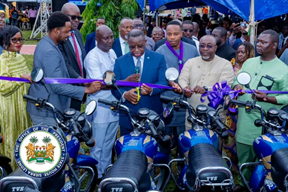
Milton Margai Technical University Campus, Goderich, Tuesday, 2 December. 2025- His Excellency President Dr. Julius Maada Bio has officially inaugurated the Alternative Livelihoods Training for Youth Bike Riders for Peace and launched the Status of the Youth Report 2025 at the Milton Margai Technical University Campus in Goderich.
The programme, titled “Empowering Youth Bike Riders as Sustainable Agents of Peace in Sierra Leone,” aims to equip bike riders with new skills to enhance their livelihoods and contribute to national development. The initiative targets 1,300 young riders and is supported by the United Nations Peacebuilding Fund.
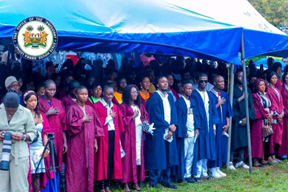
President Bio described bike riders as essential pillars of national mobility and community life. “These bike riders go to every corner of Sierra Leone. They take people to work, school, markets and hospitals. They feed their families and connect towns and villages,” he said. “This programme shows that we have not forgotten them. We understand their critical role in society.”
Addressing the matriculating riders, he emphasized that every policy and reform initiated by his government places the future of the youth at its centre. “The most important mineral for transforming Sierra Leone is human capital,” he said. “We are investing in skills training, supporting entrepreneurs, and creating pathways for young people to turn ideas into real businesses.”
The President announced ongoing work to develop a National Youth Development Framework coordinated by the Office of the President. He stressed that the road to success begins with education and skills, urging the youth to embrace the training opportunity. “Even highly educated people depend on mechanics to fix their cars,” he said. “Our future prosperity depends on you. This training is also happening in Makeni, Kenema, and Bo.”

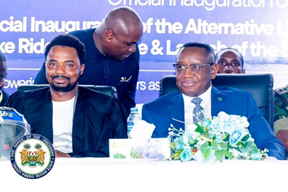
Launching the Status of the Youth Report 2025, President Bio explained that the report captures the frustrations, aspirations, and realities of Sierra Leonean youth. While it highlights progress, it also underscores challenges such as rising living costs. “This report is not meant to criticize, it reminds us that developing the youth is a responsibility, not a favour,” he emphasized.
The President strongly warned against the growing danger of Kush and other harmful drugs, calling on citizens to report all involved in the importation and distribution. “When you buy Kush, the dealers’ businesses grow and your future perishes,” he cautioned.
Prof. Philip John Kanu, Vice Chancellor and Principal of Milton Margai Technical University, said the ceremony formally welcomed the bikers as bona fide members of the university. He thanked President Bio for elevating the institution to university status and ensuring staff salaries reflect the upgrade. He also highlighted the university’s collaboration with the Ministry of Youth Affairs to approve the short courses for riders.
UN Resident Coordinator ad interim, Fredrick Ampiah, noted that bike riders represent 5% of Sierra Leone’s population—approximately 1.2 million riders. He described the programme as transformative and encouraged riders to cultivate the right skills, knowledge, and attitude to strengthen the country’s transport ecosystem.
Minister of Technical and Higher Education, Dr. Haja Ramatulai Wurie, reaffirmed that President Bio consistently places young people at the centre of national development. “This training shows what inter-ministerial collaboration can achieve,” she said.
Minister of Youth Affairs, Ibrahim Sannoh, described President Bio as a people-centred leader committed to human capital development. He explained that all youth skills training projects will now be TVET-led and conducted at Milton Margai Technical University and other TVET institutions. “There is dignity in labour. Riders will not ride forever, this training is the first step,” he said, noting that 2026 will mark 30 years of bike riding in Sierra Leone.
He added that as part of the project, bike riders’ offices in Makeni, Kenema, Bo, and Freetown are being refurbished, and new motorbikes have been purchased.
World Bank Country Manager, Abdu Muwonge, described the programme as a milestone. He advised the riders to value every job they do. “A job is about dignity, not only a paycheck,” he said. “You cannot remain bike riders forever, but this is the beginning of your journey up the job ladder.”
President of the Bike Riders Union, Ishmael Sandy, reflected on the history of bike riding in Sierra Leone, which began in 1996 when ex-combatants were trained to ride bikes as an alternative to violence. “We are riders for peace, and we say no to violence,” he declared. “Today, riders are not imprisoned because the President has provided training and opportunities for us to be responsible citizens.”
He concluded by commending President Bio’s leadership, noting the transformation the sector has witnessed under his administration.
The inauguration of the Alternative Livelihoods Training for Youth Bike Riders for Peace and the launch of the Status of the Youth Report 2025 mark a renewed national commitment to empowering Sierra Leone’s young people as drivers of peace, progress, and productivity. Through collaborative leadership across government, development partners, and the Bike Riders Union, the initiative signals a future where skills, dignity, and opportunity shape the lives of thousands of riders across the country.
As President Bio reaffirmed, the nation’s greatest resource is its people, and with continued investment in human capital, Sierra Leone’s youth stand ready to lead the next chapter of transformation.
For media inquiries, contact:
State House Media and Communications Unit
info@statehouse.gov.sl