The World Bank has reaffirmed its commitment to supporting Sierra Leone’s development agenda, with its Vice President for Africa West and Central Region, Ousmane Diagana, calling for stronger coordination, measurable results and effective implementation of programmes financed by the institution.
Diagana made the commitment during a high-level visit to Sierra Leone, where he was accompanied by the World Bank’s newly appointed Country Manager for Sierra Leone, Issatou Diallo. The delegation paid a courtesy call on the Minister of Finance, Karefa A. F. Kargbo, as part of engagements aimed at strengthening cooperation between the Government and the World Bank.
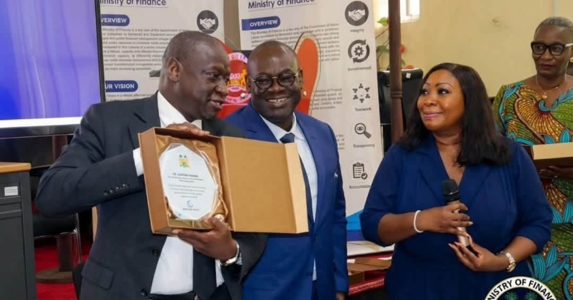
The meeting provided an opportunity for both sides to review the country’s development priorities, the World Bank’s ongoing portfolio and the need to accelerate the implementation and impact of programmes supported by the Bank.
Minister Kargbo welcomed the delegation and described the visit as an honour, while highlighting the importance of the World Bank’s extensive engagement in Sierra Leone. He noted that the institution remains a significant development partner whose financial and technical support contributes to the Government’s efforts to improve economic management and public service delivery.
Diagana congratulated Minister Kargbo on his appointment and expressed his pleasure at returning to Sierra Leone. He emphasised the importance of the World Bank’s support across key sectors, but stressed that the success of development financing must ultimately be measured by the results it delivers to citizens.
He noted that disbursements alone should not be the primary measure of success, stressing the need for financial resources to translate into tangible, measurable development outcomes. This, he said, requires stronger implementation, effective monitoring and close collaboration between the Government and development partners.
The discussions also centred on the Government’s economic priorities, particularly fiscal discipline, domestic revenue mobilisation and effective cash-flow management. Both sides also examined the World Bank’s support for social cohesion and efforts to improve access to public services across Ministries, Departments and Agencies.
Minister Kargbo assured the World Bank delegation that the Government remains committed to fulfilling agreed obligations and meeting implementation deadlines. He pointed to an estimated US$600 million financing envelope available to Sierra Leone, and stressed the importance of maintaining the conditions necessary for the country to continue accessing development financing.
He said frank dialogue, clear benchmarks and stronger coordination between the Government and the World Bank would be essential to ensuring that commitments are met and future financing opportunities are protected.
A significant part of the discussions focused on the Development Policy Operation (DPO), a World Bank financing instrument that provides budget support in connection with agreed policy and institutional reforms. Minister Kargbo underscored the importance of meeting the requirements attached to the DPO and indicated that the Government expects outstanding processes to be completed by the end of October.
The Minister further stressed that the Government recognises the World Bank as a trusted development partner with a strong understanding of Sierra Leone’s development challenges and national aspirations. He acknowledged that while the Bank has a responsibility to provide financial and technical support, the Government must equally fulfil its commitments and demonstrate measurable progress.
The engagement comes as Sierra Leone continues to pursue reforms aimed at strengthening public financial management, improving domestic resource mobilisation, expanding access to essential public services and promoting inclusive economic development.
The World Bank’s reaffirmation of support is therefore expected to further strengthen cooperation between the two institutions as Sierra Leone works to advance its development priorities and ensure that international financing produces visible and sustainable benefits for citizens.
Both sides are expected to maintain close engagement on the implementation of agreed reforms, with particular attention to meeting deadlines, strengthening institutional performance and ensuring that development programmes deliver measurable results.