By Mahmud Tim Kargbo
A judiciary does not become trusted because it occupies a grand building or produces occasional judgments of consequence. It becomes trusted when the ordinary citizen discovers that the law can actually be reached, understood and enforced. In Sierra Leone, that proposition gives Chief Justice Komba Kamanda’s reform programme a significance beyond court administration. Since taking office in December 2024, he has pursued changes that touch the physical reach of justice, the treatment of vulnerable court users, the management of cases, the use of technology and the Judiciary’s place in West Africa. Together, they suggest a more demanding conception of judicial leadership: making the machinery of justice work more convincingly for the citizen. If they endure, Kamanda’s most consequential contribution may be to make judicial legitimacy something experienced in daily life rather than discussed only in constitutional language.
The first barrier is geography. For years, the concentration of important appellate services in Freetown meant that citizens outside the capital could face substantial expenditure simply to pursue a legal remedy. Travel, accommodation, lost working time and repeated appearances can turn a constitutional right into an expensive privilege. The Judiciary of Sierra Leone, https://www.judiciary.gov.sl/, has sought to narrow that gap through expanded provincial services, resident magistrates in district headquarters, a magistrate court in Mile 91 and strengthened judicial capacity in Kono. The significance is greater than convenience: a national institution becomes more legitimate when citizens encounter it where they live. The United Nations, https://www.un.org/sustainabledevelopment/peace-justice/, places access to justice and effective, accountable and inclusive institutions at the centre of Sustainable Development Goal 16.
This reform also changes an older understanding of the state. When justice is concentrated in the capital, distance silently decides who can sustain a claim and who eventually gives up. Bringing courts closer does not merely reduce transport costs; it tells citizens that national institutions belong to them as much as to those who live near the centre of government. The United Nations rule of law framework, https://www.un.org/ruleoflaw/, treats access to justice, accountability and equality before the law as essential elements of legitimate governance. Sierra Leone’s provincial expansion can therefore be read as an institutional correction to a geographical inequality that formal rights alone cannot resolve. The test will be whether a litigant in a distant district begins to regard the court as an ordinary public service rather than a remote national institution.
The same principle applies to vulnerable people whose difficulty is not distance but the nature of the courtroom itself. A survivor of sexual violence or a child may technically have access to justice while remaining poorly equipped to navigate procedures designed around adult, conventional participants. The establishment of the Sexual Offences Model Court in Bo is important because it attempts to make the courtroom more responsive to that reality. The Judiciary’s official account, https://www.judiciary.gov.sl/?mo=8&p=1685&yr=2026, says the court was designed to provide an enabling environment for young victims and vulnerable witnesses while preserving dignity and self esteem. The African Union, https://au.int/en/democracy-law-human-rights, places human rights, justice and the rule of law within the continent’s institutional framework. Specialisation, properly implemented, is an attempt to make equal protection credible for people whose circumstances make ordinary procedures disproportionately difficult.
The next measure is time. A court can be geographically accessible and still fail citizens if cases disappear into administrative delay, files are difficult to trace or routine procedures consume judicial attention. This is where Kamanda’s modernisation agenda becomes more consequential than a simple technology upgrade. The Judiciary’s e Justice initiative, https://www.judiciary.gov.sl/?mo=6&p=1696&yr=2026, forms part of an effort to modernise court administration and improve the management of judicial information. The Commonwealth, https://thecommonwealth.org/our-work/promoting-rule-law, treats effective institutions and judicial capacity as practical foundations of the rule of law. Digitalisation will have achieved little if it merely replaces paper with screens; its value lies in giving judges more control over their work and court users greater certainty about theirs.
Yet speed is not the same as justice. A court that disposes of cases rapidly but cannot command confidence in the independence of its decisions would be efficient only in an administrative sense. The Commonwealth’s Latimer House Principles, https://thecommonwealth.org/sites/default/files/news-items/documents/LatimerHousePrinciplesFG7Jul17.pdf, identify an independent, impartial, honest and competent judiciary as central to the rule of law and public confidence. The African Commission on Human and Peoples’ Rights, https://achpr.au.int/en/adopted-resolutions/21-resolution-respect-and-strengthening-independence-judic, has likewise treated judicial independence as essential to democratic governance. Infrastructure can improve the machinery, technology can accelerate the process and professional training can strengthen competence, but only independence gives the resulting decision the authority that makes a court worthy of public trust.
That trust also reaches beyond constitutional principle into economic life. A country seeking investment cannot ask businesses to rely on commercial opportunity while leaving uncertainty about how disputes will be resolved. Contracts need credible enforcement, property disputes need impartial adjudication and businesses need confidence that legal uncertainty will not become an indefinite cost. The United Nations, https://sdgs.un.org/goals/goal16, connects effective, accountable institutions and the rule of law with sustainable development. For Sierra Leone, judicial reform should therefore be understood as part of the country’s economic infrastructure. A strong Judiciary cannot create investment by itself, but it can reduce one of the risks that investors are least willing to price blindly: uncertainty about whether rules will be applied consistently.
Kamanda’s regional responsibilities have added another dimension to the reform story. As Chairman of the ECOWAS Judicial Council, he has helped place Sierra Leone within a regional discussion about judicial cooperation, constitutional democracy, human rights and the rule of law. ECOWAS, https://www.ecowas.int/ecowas-judicial-council-reaffirms-commitment-to-strengthening-justice-rule-of-law-and-promotion-of-human-rights-and-constitutional-democracy-in-west-africa/, reported on the Council’s Freetown meeting in April 2026 and its reaffirmation of those principles. Regional cooperation allows institutions to exchange judicial knowledge and strengthen common standards. Sierra Leone’s regional influence is therefore useful not simply as diplomatic prestige but as an opportunity to confront legal challenges that cross national borders. Its credibility abroad, however, will always be tested against the performance of its courts at home.
The wider African setting reinforces that point. The African Union’s Charter on Democracy, Elections and Governance, https://au.int/en/treaties/african-charter-democracy-elections-and-governance, places constitutionalism, the rule of law, human rights and separation of powers within Africa’s shared governance commitments. Sierra Leone’s judicial reforms should consequently be understood as part of a continental institutional conversation rather than an isolated national experiment. Kamanda’s participation in international judicial forums, including specialist discussions on maritime law, gives the country an opportunity to contribute expertise in areas increasingly important to trade, shipping and the Blue Economy. Such engagement has value when it returns home as stronger jurisprudence, better professional practice and deeper institutional capacity. International recognition matters only when it strengthens domestic performance.
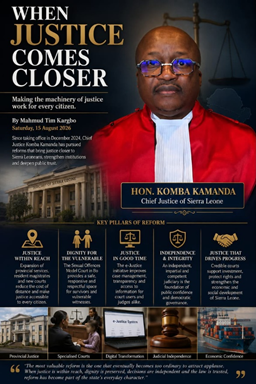
The decisive question, however, is permanence. A reform programme built around one office holder can be energetic without being durable, because courts require continuity in funding, appointments, training, infrastructure, technology and professional standards. The Commonwealth’s rule of law work, https://thecommonwealth.org/our-work/promoting-rule-law, emphasises the institutional conditions necessary for effective justice and judicial independence. Sierra Leone therefore needs to convert individual reforms into institutional habits. Provincial access must become normal, digital systems dependable, specialised courts properly supported and judicial independence protected regardless of who occupies the Chief Justice’s office. The measure of Kamanda’s legacy will not be how much changed while he was in office, but how much remains after he has left it.
The most valuable reform is the one that eventually becomes too ordinary to attract applause.
When citizens can reach a court without prohibitive cost, when vulnerable witnesses can participate without surrendering their dignity, when judges can decide without interference and when businesses can rely on predictable adjudication, reform has moved beyond announcement. It has become part of the state’s everyday character. That is the standard by which Kamanda’s tenure should ultimately be judged. Sierra Leone does not need a Judiciary that merely looks modern from the outside; it needs one whose independence is assumed, whose efficiency is felt and whose doors are genuinely open to the citizen. If the present reforms achieve that permanence, their significance will extend beyond one Chief Justice. They will mark the point at which justice ceased to be something Sierra Leoneans had to travel towards and became something the state consistently brought within their reach.