By Mahmud Tim Kargbo
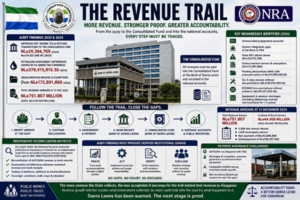
Revenue can rise faster than accountability unless the trail beneath it keeps pace. Sierra Leone’s 2024 audit records domestic revenue of NLe14.864 billion, while Customs and Excise receipts rose from NLe1.734 billion in 2023 to NLe2.684 billion in 2024. Those gains answer the first question of public finance: how much was collected. The harder question is whether the State can trace a material transaction from the cargo that entered the country, through its Customs declaration and assessment, to payment, transfer into the Consolidated Fund and recognition in the national accounts. The 2023 and 2024 findings of the Audit Service Sierra Leone show weaknesses at several points in that chain. Revenue mobilisation is improving, but revenue assurance must now catch up.
That distinction matters because an unqualified audit opinion is not a certificate that every internal control works. The Auditor General’s 2024 opinion provides reasonable assurance that the Consolidated Fund statements are free from material misstatement, while distinguishing that responsibility from an opinion on internal control. The accounts may therefore fairly present Government’s financial position even when systems producing, transferring and reconciling individual revenue transactions contain weaknesses. The public interest lies in the space between what the accounts report and what the underlying records can prove. The official archive contains the 2023 and 2024 annual reports: Audit Service Sierra Leone annual reports. A clean opinion is assurance about the statements, not proof that every revenue trail is intact.
The warning was already visible in the 2023 audit. Audit Service Sierra Leone reported NLe34,527,680.85 in GST and Income Tax remittances and ASYCUDA World prepayment account transactions involving oil marketing and mining companies that could not be traced to the Consolidated Fund at the Bank of Sierra Leone. The finding included NLe494,059.87 in GST, NLe1,033,094.07 in Income Tax and NLe33,000,526.91 in ASYCUDA transactions, while requested SWIFT evidence was not submitted. The finding did not establish that NLe34.53 million had been stolen; it established that the evidence available to auditors did not allow the transactions to be followed into the Consolidated Fund. Public money should not become difficult to locate simply because it has crossed from one institutional record to another.
The problem becomes clearer when reconciliation is treated as the bridge between records that should describe the same financial reality. The 2023 audit identified a failure to reconcile the ASYCUDA World prepayment account maintained by Customs with the Consolidated Fund in relation to petroleum transactions. Without reconciliation, Customs can show one position, a bank another and the Treasury a third, with no reliable explanation for the difference. That is a weakness in the architecture of public revenue management, not mere administrative untidiness. A stronger system would expose each material discrepancy, assign responsibility for resolving it and preserve the evidence of resolution. Revenue growth therefore creates a higher standard of proof, because larger collections make reliable reconciliation more consequential.
The 2024 audit provides the next test, and the answer is not yet comfortable. It records another NLe29,394,709 in transactions involving GST and Income Tax remittances and prepayment accounts of oil marketing and mining companies that could not be traced to the Consolidated Fund at the Bank of Sierra Leone. That figure is lower than the NLe34,527,680.85 reported in 2023, but it would be wrong to treat the difference as proof that the weakness improved by NLe5.13 million. The two audit populations have not been shown to be identical, and the 2024 finding does not demonstrate that every earlier exception had been resolved. The defensible conclusion is narrower: a material traceability weakness identified in 2023 was followed by another in 2024.
The audit trail also weakens where revenue is assessed, adjusted or waived. The 2024 report found that ASYCUDA World was not integrated with the Integrated Tax Administration System, making real time reconciliation difficult, and reported false GST refund claims of NLe34,073,158. It also recorded tax and duty waivers of NLe118,230,289.04 without required documentation, ECOWAS levy exemptions of NLe50,651,524.66 without documentary evidence in ASYCUDA, and NLe4,010,047.21 in waivers and exemptions granted to NGOs not listed in the relevant gazette. These figures should not be casually described as stolen revenue, because the findings concern verification, legality, documentation and revenue foregone. They do show that significant decisions affecting public receipts were not consistently supported by records capable of independent reconstruction.
The petroleum finding shows why the chain must begin with the calculation of what an importer owes. The Auditor General reported differences arising from Customs’ application of the National Petroleum Regulatory Authority’s Single Pricing Formula rates, including NLe313,838,549.13 in import duties, NLe7,801,221.25 in excise duties and NLe57,776,144.92 in Infrastructure Development Fund levy, producing NLe379,415,915.30 reported as unpaid by oil marketing companies. That figure should not be added to the NLe29.394 million untraced to the Consolidated Fund because the findings concern different stages of the revenue process. The same discipline applies to 644 ASYCUDA declarations carrying assessed duties and taxes of NLe111,892,600.60 that remained pending without reported follow up. The proper question is not whether that money was lost, but what happened to each liability after assessment.
Arrears reinforce the same principle without being confused with the other findings. At 31 December 2024, the Auditor General reported total revenue arrears of NLe751.807 million, compared with NLe730.024 million in 2023, while Customs and Excise arrears fell from NLe108.798 million to NLe44.959 million. These figures measure outstanding obligations and should not be added to pending declarations or untraced transactions, which arise at different stages. Their importance is what happens after Government establishes that an obligation exists: payment must be recorded, non -payment pursued and lawful adjustments documented. The 2024 audit also identified 5,904 late annual returns, 1,309 incomplete returns, non- payment of NLe43,898,898 and underpayment of NLe338,937,900. Collection is only half of revenue administration; enforcement and evidence complete the chain.
The National Revenue Authority has recognised that the answer must involve independent reconciliation. On 3 April 2025, it published an Expression of Interest for an independent audit firm to reconcile Customs revenue with transit bank reports, under procurement reference NRA/ICAD/EOI/2025/058: National Revenue Authority public notice. Its terms called for reconciliation of ASYCUDA World revenue against transit bank records, examination of differences between assessed revenue and bank receipts, and testing of deletions, additions and misclassifications. The scope also covered containers, bulk cargo and valuation, recognising that financial reconciliation cannot correct an import that was never properly captured. The next question is whether that exercise was completed and whether its findings and corrective actions have been disclosed sufficiently for public scrutiny.
The strongest test would follow the transaction from the physical border to the national accounts and back again. A shipping manifest should connect to the importer, Customs declaration, assessment, payment, bank receipt, transfer to the Consolidated Fund and Government accounting entry. The reverse trail should work too, so that a Consolidated Fund receipt can be traced back through the bank and Customs payment to the declaration and import. ASYCUDA audit logs should show whether a declaration changed, who changed it, when it changed, what the original assessment was and what authorised the revision. The 2024 audit also records shortages of computers, scanners, generators and communication equipment at several border offices, inadequate mobility among provincial border guards and a Gbalamuya scanner reported as non- functional for more than five years. Revenue assurance must therefore begin with knowing what entered the country and end only when the resulting public money can be proved in the accounts.
The final test is whether audit findings produce verified institutional change. Audit Service Sierra Leone says that since 2020 it has tracked recommendations in Management Letters and Auditor General’s reports through a digital tracking system, while acknowledging that it had not yet conducted the follow up audits needed to determine actual implementation: Audit Service Sierra Leone other reports. Its February 2025 engagement with the National Revenue Authority focused on implementing audit recommendations and addressing technological challenges: Audit Service engagement with the NRA. Government should now be given every opportunity to demonstrate corrective evidence. If the untraced transactions, petroleum assessment differences, pending declarations and documented waivers have been reconciled, recovered, lawfully adjusted or otherwise resolved, the records should show how. Accountability is complete only when the correction itself can be independently verified.
Sierra Leone has been warned. The next stage is proof.
The more revenue the State collects, the less acceptable it becomes for the trail behind that revenue to disappear into institutional gaps. Citizens should be able to follow an import from the quay to Customs, from Customs to the bank, from the bank to the Consolidated Fund and from the Fund into the national accounts without losing the thread. Revenue growth tells the country what Government collected; an intact audit trail tells the country what happened to it. The real measure of a stronger revenue system is therefore not simply a larger total, but a smaller distance between collection and proof. When that distance disappears, higher revenue becomes evidence that the State can account for what it asks citizens and businesses to entrust to it.