By Mariama Benovia Davies
The Executive Secretary of the Independent Commission for Peace and National Cohesion (ICPNC), Hawa Sally Samai, has emphasized the need for sustained dialogue, commitment, and collective action to strengthen peace and national unity in Sierra Leone.
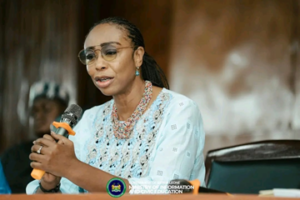
Speaking on the topic “The ECOWAS Summit and the Implications for Peace and National Cohesion” during the Weekly Press Conference organized by the Ministry of Information and Civic Education at the Miatta Civic Centre, Madam Samai said the recent national developments provide an opportunity to deepen reconciliation and strengthen relationships among political actors and citizens.
The press conference was hosted by the Minister of Information and Civic Education, Chernor Bah, and brought together members of the media and key stakeholders to discuss issues relating to governance, peace, and national development.
Samai said one of the first questions that came to mind following the announcement of recent political engagements was what the development meant for the Peace Commission and how it could contribute to strengthening unity within the country.
She acknowledged concerns raised by some citizens regarding the involvement of individuals with links to Sierra Leone’s conflict history, but stressed that the priority now should be ensuring that agreements reached by political actors are fully implemented.
According to her, the commitment by political stakeholders to rebuild relationships within Sierra Leone’s national, social, political, and economic landscape represents an important step towards strengthening peace.
She noted that this includes improving relationships between the Presidency, former political leaders, former presidents and vice presidents, as well as leadership structures of major political parties, including the All People’s Congress (APC) and the Sierra Leone People’s Party (SLPP).
“The question now is: what happens next?” Madam Samai said, emphasizing that peacebuilding requires continuous engagement beyond the signing of agreements.
She explained that the mandate of the ICPNC is to look beyond the immediate announcements and focus on ensuring that peace efforts translate into meaningful action.
Samai revealed that the Commission has already begun engaging political actors and stakeholders to better understand their interpretation of the agreements and their willingness to contribute to the process.
She said the role of the Commission is to support dialogue by listening to concerns, asking critical questions, and creating platforms where citizens and institutions can openly discuss issues affecting national cohesion.
“The most important thing is that we move beyond words and ensure that actions follow,” she stated.
The Executive Secretary stressed that maintaining peace is not the responsibility of government alone, but requires the participation of political parties, civil society organizations, communities, security institutions, and citizens.
She noted that Sierra Leone’s history, particularly the devastating civil war, serves as a reminder of the importance of protecting peace and preventing a return to division and conflict.
According to Samai, peace must be understood as a continuous process that requires patience, understanding, compromise, and respect for different perspectives.
She said agreements reached during national dialogue processes must have practical outcomes, adding that commitments made at negotiation tables must be followed by implementation.
The ICPNC Executive Secretary highlighted the importance of learning from international experiences, noting that countries that have experienced conflict and division have often relied on dialogue and reconciliation mechanisms to rebuild trust.
She explained that the Commission’s responsibility is not to impose solutions but to facilitate conversations and create spaces where stakeholders can engage honestly and constructively.
Samai also referenced the recommendations of the Truth and Reconciliation Commission (TRC), noting that lessons from Sierra Leone’s past remain important in shaping the country’s future.
She disclosed that several TRC recommendations still require implementation, with assessments indicating that approximately 61 percent of the recommendations remain outstanding.
She said these recommendations cover critical areas including social conditions, governance, reconciliation, and national healing.
“The responsibility for peacebuilding does not belong to one person or one institution. It requires collective effort,” she said.
Samai emphasized that national cohesion depends on ensuring that every Sierra Leonean feels included, regardless of political affiliation, community, or religious background.
She warned against allowing political differences to create divisions, stressing that citizens must feel safe enough to participate in national conversations without fear or intimidation.
“Sierra Leone belongs to all of us,” she said, encouraging citizens to protect the country’s reputation as a peaceful nation.
She added that Sierra Leone’s transition from conflict to peace remains an achievement worthy of protection, and that maintaining this progress requires continued commitment from all sectors of society.
The ICPNC Executive Secretary concluded by reaffirming the Commission’s commitment to supporting initiatives that promote dialogue, reconciliation, and national cohesion.
She said Sierra Leone’s example of peacebuilding sends a strong message not only across Africa but also to the international community, demonstrating the importance of unity, democratic engagement, and peaceful coexistence.