The Director General of the National Petroleum Regulatory Authority (NPRA), Brima Baluwa Koroma, has briefed Parliament’s Committee on Trade and Industry on recent developments in Sierra Leone’s downstream petroleum sector.
The engagement followed the committee’s summons of the NPRA and Oil Marketing Companies (OMCs) as part of its oversight responsibilities.
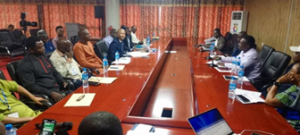
During the session, Baluwa outlined the Authority’s key legislative mandate under the National Petroleum Regulatory Authority Act, 2025, highlighting its regulatory role in ensuring an efficient, competitive, and safe downstream petroleum industry.
He told the committee that the Authority balances the interests of three key stakeholders: consumers, industry operators, and the Government. According to him, protecting consumers through fair fuel pricing remains a top priority, while ensuring that operators receive reasonable returns on investment, which is essential to encourage both domestic and foreign investment. He added that the Authority also supports Government’s fiscal objectives by promoting sustainable revenue generation from the petroleum sector.
Responding to questions on the quality of petroleum products imported into Sierra Leone, Koroma assured Members of Parliament that petroleum products entering the country meet internationally accepted quality standards. He explained that modern fuels contain additives that improve engine performance, while incorporating environmentally friendly technologies that reduce harmful emissions.
He further disclosed that the NPRA will engage the United Nations Environment Programme (UNEP) in August to discuss issues relating to fuel quality and vehicle emissions. He said the Authority would be pleased to have one or two representatives from the Parliamentary Committee on Trade and Industry participate in the discussions.

On regional fuel quality standards, Koroma explained that ECOWAS has transitioned from the 1,000 parts per million (ppm) sulphur standard to 50 ppm as part of efforts to improve environmental protection and public health. He noted that Sierra Leone’s fuel pricing framework currently accommodates the importation of petroleum products with a sulphur content of 10 ppm, which exceeds the regional benchmark.
The Director General also commended the Ministry of Finance for securing a Platts subscription for the Authority in 2020, noting that prior to then, the regulator depended on Oil Marketing Companies for international petroleum price information. He said the subscription has strengthened transparency and independence in determining fuel prices.
Baluwa Koroma also praised Oil Marketing Companies for maintaining high standards in the quality of petroleum products supplied to the Sierra Leonean market.
On the regulation of fuel stations, the Director General informed the committee that the Authority has enforced a moratorium on the construction of new filling stations since March, while it reviews existing applications. He said the review aims to ensure compliance with safety and environmental standards, adding that some proposed stations may be approved while others will be rejected in the interest of public safety.
He also shared copies of the NPRA’s Gas Station Regulations to Members of Parliament and called for their support in sensitising communities on the dangers of constructing filling stations close to schools, hospitals, markets, and other public institutions.
𝐍𝐏𝐑𝐀 𝐌𝐞𝐝𝐢𝐚 𝐚𝐧𝐝 𝐏𝐮𝐛𝐥𝐢𝐜 𝐑𝐞𝐥𝐚𝐭𝐢𝐨𝐧𝐬 𝐃𝐞𝐩𝐚𝐫𝐭𝐦𝐞𝐧𝐭