VP Jalloh Gives Update On Reforms & Investment Drive in London
The Government of Sierra Leone has intensified its outreach to citizens abroad, with Vice President Dr. Mohamed Juldeh Jalloh using the London Civic Day Town hall on 18 June 2026 to present a broad update on national reforms, development priorities, and opportunities for diaspora engagement.
The engagement, held at Westminster Chapel in London and hosted under the Civic Day Series by the Ministry of Information and Civic Education, brought together Sierra Leonean professionals, community leaders, development partners, and government officials in a structured dialogue focused on governance, economic transformation, and national cohesion.
Rather than a routine policy briefing, the townhall increasingly reflected a strategic shift in government communication—positioning the diaspora not only as observers of national development, but as active stakeholders in shaping it.
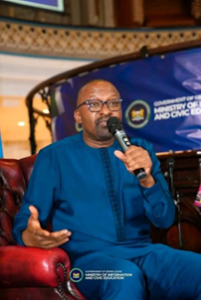
Vice President Jalloh emphasized that Sierra Leone’s development agenda is anchored on strengthening institutions, expanding economic opportunity, and building stronger linkages with citizens abroad. He noted that sustained national progress depends on inclusive participation, including contributions from Sierra Leoneans in the UK and other parts of the world.
A major focus of his address was the role of diaspora skills, investment, and knowledge transfer. He described the global Sierra Leonean community as an “essential development partner,” particularly in sectors such as infrastructure, agriculture, energy, and human capital development.
On governance and security, he highlighted reforms introduced following the 2023 security incidents, including improvements in coordination and professionalism within security institutions, as well as ongoing efforts to decentralize recruitment to promote fairness and national representation.
The Vice President also pointed to economic transformation initiatives, especially in the energy sector, where government investments in solar and other renewable sources are gradually expanding electricity access. He reiterated the administration’s target of significantly increasing national electricity coverage by 2030 as part of its broader economic modernization plan.
Agriculture featured prominently through the Feed Salone programme, which he framed as central to reducing food imports and strengthening food sovereignty. The initiative focuses on scaling up local production in rice, livestock, and poultry while improving rural infrastructure to support farmers.
Mining sector reforms were also outlined, with emphasis on transparency measures and community development obligations for extractive companies. According to the Vice President, these reforms are intended to ensure that mineral wealth generates more visible benefits at the local level, particularly in education, healthcare, and infrastructure.
He further addressed public health priorities, noting increased attention to nutrition as a key determinant of maternal and child health outcomes. Government interventions, he said, now include targeted nutrition programmes, dedicated funding allocations, and community-based health initiatives.
Beyond policy updates, the engagement also confronted social challenges, particularly the rise of synthetic drug abuse. The Vice President outlined a dual response involving law enforcement action and rehabilitation support aimed at addressing both supply and recovery needs.
Participants at the forum contributed actively, raising concerns about governance, accountability, and economic opportunity while also highlighting the growing role of remittances and diaspora investment in sustaining households and supporting development projects in Sierra Leone.
Calls were made for stronger institutional mechanisms to facilitate diaspora participation in national development, with many attendees urging more structured investment channels and improved communication between government and overseas communities.
The townhall is part of a broader government strategy to expand civic engagement and rebuild trust through direct dialogue, particularly with citizens living outside the country. It reflects an increasing emphasis on transparency, participation, and shared responsibility in national development planning.
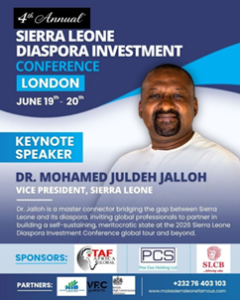
Following the event, Vice President Jalloh is expected to participate in the Fourth Sierra Leone Diaspora Investment Conference in London, where discussions will focus on mobilizing diaspora capital for key growth sectors including agriculture, technology, tourism, and infrastructure.
Together, these engagements signal a deliberate effort by the Government of Sierra Leone to reposition the diaspora as a central pillar of its long-term development strategy.