By Alimamy Kabia aka Tiger
As Sierra Leone moves steadily toward the next electoral cycle, the national conversation must increasingly focus on a fundamental question: what kind of leadership is required to unite the country, strengthen institutions, and translate public policy into shared prosperity?
For many observers within and beyond the All People’s Congress (APC), Dr. Ibrahim Bangura’s emergence on the national political stage represents an attempt to answer that question. His growing appeal is not rooted merely in political ambition, but in a leadership message centered on three interconnected objectives: Heal. Unite. Build.
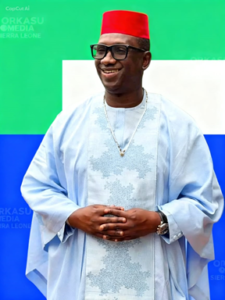
At a time when political polarization continues to challenge many democracies across the world, Sierra Leone requires leaders capable of bringing citizens together around common national goals. Economic transformation, institutional reform, job creation, educational advancement, and social cohesion cannot be achieved through division. They require trust, cooperation, and a shared sense of national purpose.
Dr. Ibrahim Bangura’s central proposition is therefore not simply about winning political office. It is about building partnerships between government and citizens, between public institutions and communities, and between national aspirations and practical policy outcomes. In essence, he is asking Sierra Leoneans to become partners in transforming national policy into prosperity for all.
This emphasis on partnership is particularly important for a country whose future depends on harnessing the talents and contributions of all its people. Sustainable development cannot be imposed from above. It must be built through inclusive participation, accountability, and collective ownership of national progress.
The challenge facing Sierra Leone is not merely economic; it is also institutional. Strong democracies require strong institutions.
Parliamentary oversight exists to strengthen transparency and accountability, not to undermine the independence of public institutions. Effective governance depends upon a healthy balance between oversight, responsibility, and institutional integrity. A mature democracy is one where institutions serve the public interest rather than partisan interests.
Equally important is the principle of equal opportunity. National development reaches its full potential only when citizens are judged by their competence, character, and contribution rather than by ethnicity, region, religion, or political affiliation.
This principle is already reflected in everyday life. When passengers board an aircraft, they do not ask about the tribe of the pilot. When they enter a taxi or a poda-poda, they do not inquire about the driver’s regional background. What matters is capability, professionalism, and trust. The same standard should guide the nation’s approach to leadership and public service.
It is within this context that Dr. Ibrahim Bangura seeks the APC flagbearership and leadership. His candidacy is being presented not as a vehicle for grievance or division, but as an opportunity to renew the party’s connection with a broader national constituency. By rejecting bitterness and embracing reconciliation, he seeks to position himself as a unifying figure capable of appealing across traditional political and social boundaries.
The APC’s forthcoming National Delegates Conference will therefore represent more than an internal party event. It will be a test of the party’s readiness to present a vision that speaks to the aspirations of a new generation of Sierra Leoneans. Delegates will be tasked not only with electing a flagbearer but with making a choice about the future direction of the party and its capacity to compete effectively in 2028.
Political success is not ultimately determined by campaign slogans, T-shirts, billboards, or social media messaging. These tools may enhance visibility, but they do not substitute for credibility. The true measure of political marketing is found on the ballot paper, where citizens evaluate leadership, vision, competence, and trustworthiness.
As the APC prepares for this defining moment, delegates carry a responsibility that extends beyond partisan calculations. Their decision will help determine whether the party presents to the nation a leader capable of uniting diverse constituencies, strengthening democratic governance, and advancing a development agenda that benefits all Sierra Leoneans.
The broader lesson extends beyond any individual candidate. Sierra Leone’s future will depend on leaders who can bridge divides, strengthen institutions, promote equal opportunity, and convert national resources into shared prosperity. It will depend on leaders who understand that political victory is meaningful only when it serves a larger national purpose.
In that regard, Dr. Ibrahim Bangura’s message offers a framework that resonates beyond party politics: heal divisions, unite communities, and build a stronger, more prosperous, and more inclusive Sierra Leone.
The ultimate question before delegates and citizens alike is not merely who can win an election. It is who best help Sierra Leone can realize its untapped potential and move confidently toward a future defined by unity, opportunity, and national progress.