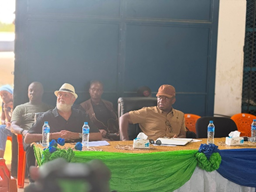
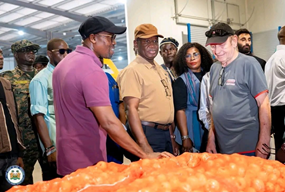
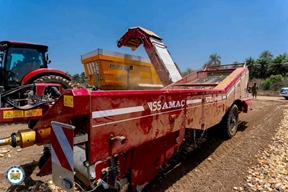
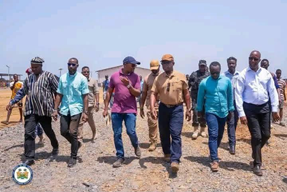
President of Sierra Leone, Julius Maada Bio, on Thursday 16th April 2026, paid his second official visit to Pee Cee Agriculture Limited, a subsidiary of Pee Cee Holdings, where he participated in a symbolic harvest marking significant progress in the country’s agricultural transformation agenda.
The visit, which drew key government officials, private sector stakeholders, and local community leaders, served as both a celebration of success and a reaffirmation of the government’s commitment to boosting local food production. At the heart of the engagement was the company’s remarkable expansion in onion cultivation, which now covers up to 70 hectares for the 2026 farming season.
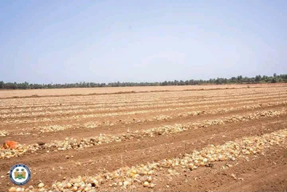
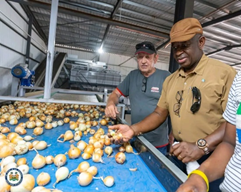
Even more impressive is the company’s forward-looking vision. Having already cleared an additional 100 hectares of land, Pee Cee Agriculture has announced plans to scale up operations to a total of 170 hectares next year. This ambitious expansion positions the company as a key driver in Sierra Leone’s push to reduce reliance on imported food commodities, particularly onions.
The project is being implemented with support from the International Finance Corporation, the private sector arm of the World Bank, underscoring international confidence in Sierra Leone’s agricultural potential.
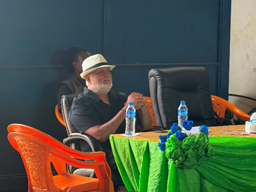
Under the leadership of prominent businessman Mahesh Choithram Nandwani, Pee Cee Holdings has grown into a formidable force in the country’s economy. With over 1,500 local employees and approximately 24 retail outlets nationwide, the company’s footprint extends across multiple sectors. Its portfolio includes Pee Cee and Sons Limited, Jolaks Manufacturing Company, and Milla Group Limited.
Speaking during the event, Nandwani described the occasion as “a massive celebration of success,” reflecting on his journey from a modest trader at age 15 to a leading industrialist and now a passionate advocate for agriculture. He revealed that although he established his first factory in 2000, his current focus has shifted significantly toward farming.
“We are now more interested in farming than industry and trading,” he said, emphasizing the importance of agriculture in national development. He also disclosed that the company owns an oil refinery and plans to cultivate palm canal as raw material for processing and manufacturing, further strengthening vertical integration within its operations.
Nandwani used the opportunity to call on Sierra Leoneans to embrace agriculture as a viable and profitable venture. He assured stakeholders of continued investment in the sector, noting that increased production and productivity are essential to economic growth and food security.
Minister of Agriculture, Henry Musa Kpaka, commended Pee Cee Holdings for its strong support to the government’s flagship Feed Salone Programme. He highlighted the company’s impressive yield growth, noting that production has surged to 55 tonnes per hectare from an initial five hectares during the early stages of the project.
“This is a clear demonstration that the private sector can lead the way,” Dr. Kpaka said. “The work of Pee Cee Holdings has already contributed to reducing onion imports and lowering market prices, making this essential commodity more affordable for Sierra Leoneans.”
He urged other private sector players to emulate Pee Cee’s example, stressing that sustainable agricultural development requires collective effort. The Minister also expressed gratitude to President Bio for his visionary leadership and to Nandwani for translating that vision into tangible results.
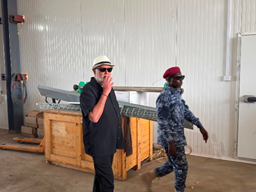
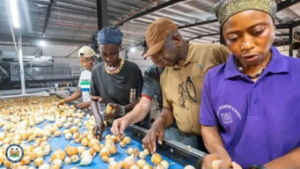
Providing technical insights into the project, Senior Agronomist and Deputy Farm Manager at Pee Cee Agriculture, John Lahai Allieu, disclosed that the company now operates a modern storage and packaging facility capable of handling onions for both local markets and export.
He explained that the facility includes storage units with a combined capacity of over 2,000 tonnes, as well as drying and processing plants. The processing center alone cost approximately $2 million, reflecting the scale of investment committed to the project.
Allieu acknowledged initial challenges, particularly with soil fertility, which limited yields to between 9 and 10 tonnes per hectare in the first year. However, through improved soil nutrient management, yields have significantly increased. He projected that the current 70 hectares could produce up to 35,000 tonnes, with expectations to double output to 70,000 tonnes as expansion continues.
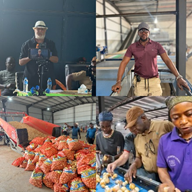
The farm is also supported by a reservoir with a capacity of 80 million liters, ensuring a reliable water supply for irrigation. Despite ongoing challenges such as theft, water management, and workforce development, Allieu expressed confidence in the project’s sustainability.
During the visit, the Presidential Spokesman highlighted the dramatic transformation of the farmland, which was previously dense bush. Today, it stands as a model of agricultural innovation and productivity.
“This is a shining example of what can be achieved when vision meets commitment,” he said, adding that the government is willing to provide additional land to support the company’s expansion.
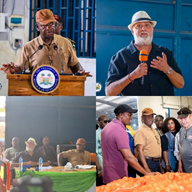
In his address, President Bio expressed satisfaction with the progress made, praising Pee Cee Holdings for being the first major private sector entity to respond to the government’s call for increased local production of onions and other essential commodities.
“The only way we can succeed in agriculture is through strong collaboration between the public and private sectors,” the President stated. He urged local communities to protect and support the farm, emphasizing its importance to national development.
President Bio also called on the international community to support such initiatives, reiterating his government’s determination to reduce imports of key food items including onions, rice, and eggs. He further commended the company for empowering local communities, particularly women, through employment opportunities.
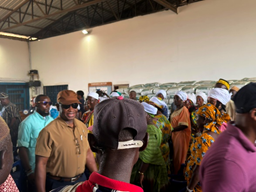
Earlier, Paramount Chief of Lokomasama Chiefdom, Komrabai Shebora Lakka II, expressed gratitude to the President and Pee Cee Agriculture for their contributions to local development. He noted that the project in Mathen Village has created jobs and improved livelihoods in both Lokomasama and Kafu Bullom Chiefdoms.
He assured continued community support for the initiative, describing it as a vital source of economic empowerment for local residents.