By Mahmud Tim Kargbo
Wednesday, 25 March 2026
In a move that has reverberated across Sierra Leone’s legal and commercial communities, the nation’s Chief Justice has intervened to free a petty trader whose imprisonment has come to symbolise deeper questions of power and justice.
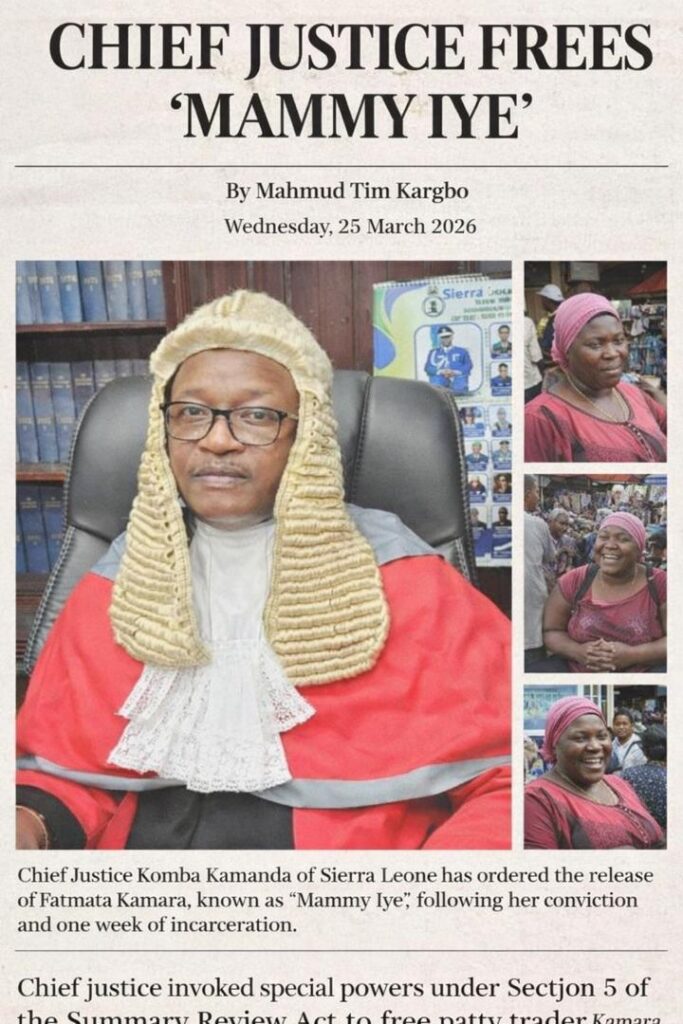
Sierra Leone’s Chief Justice, Honourable Justice Komba Kamanda, ordered the immediate release of Madam Fatmata Kamara, widely known as “Mammy Iye,” following her conviction and one week of incarceration at the Female Correctional Centre.
The directive, issued pursuant to Section 5 of the Summary Review Act, Cap 17 of the Laws of Sierra Leone 1960, underscores the authority of the Chief Justice to review decisions of Magistrates’ Courts without the necessity of a formal appeal.
A Dispute Turns Criminal
Madam Kamara had been arraigned before the York Magistrate’s Court on two counts of Public Insult and Provocation under Sections 2 and 3 subsection 1 of the Public Order Act of 1965.
According to court documents, the incident occurred on 5 March 2026 at a welding shop at New Jersey Junction in Goderich, Freetown, when the complainant, a serving Magistrate, approached the trader to purchase food. A disagreement reportedly escalated into an exchange deemed criminal under public order laws.
Mammy Iye pleaded guilty to both charges and was subsequently convicted and sentenced, leading to her detention for one week prior to the intervention from the Chief Justice.
A Safeguard Against Imbalance
The Summary Review Act provides Sierra Leone with a uniquely efficient mechanism for judicial correction, enabling swift intervention where necessary. Its importance is particularly evident in cases where disparities in authority risk influencing outcomes.
Where one party occupies a position of institutional power, concerns may arise regarding fairness, perception, and proportionality. In such instances, the Summary Review process acts as a vital safeguard, ensuring that justice is neither overshadowed by influence nor denied to those lacking the means to pursue lengthy appeals.
Though rarely invoked, legal scholars note that the Act has historically been reserved for instances where judicial discretion appears to have strayed beyond reasonable bounds. Its selective application reinforces its authority and demonstrates the judiciary’s commitment to fairness and oversight.
Legal and Civil Society Perspectives
Senior human rights lawyer stated:
“While the conviction may have followed due process, the sentence raises legitimate concerns about proportionality. The Summary Review Act is designed to address precisely such situations.”
Civil society advocate Hindolo Conteh added:
“This case exposes the vulnerability of those in the informal sector. Justice must remain accessible and fair, regardless of social standing.”
Offering an international perspective, Professor Richard Susskind has consistently argued that modern justice systems must prioritise accessibility and efficiency, particularly for those unable to navigate complex legal processes, principles that resonate strongly with the use of summary review.
Public Reaction and Socio Economic Reality
At New Jersey Junction in Goderich, the response has been immediate and deeply personal.
Mariatu Bangura, a fellow trader, remarked:
“We all have disagreements with customers. It should not mean prison. We are relieved she is free.”
Another resident observed:
“Those in authority must understand everyday struggles. Not every argument should end in punishment of this kind.”
These reactions reflect a wider structural reality. According to the World Bank, as of 2022, approximately 80 to 90 percent of employment in Sierra Leone is concentrated within the informal sector, with petty trading forming a significant share of urban economic activity.
Reference: https://www.worldbank.org/en/country/sierraleone
The United Nations Development Programme further reports that women constitute over 60 percent of participants in informal trading activities, underscoring the gendered dimension of economic vulnerability in urban centres.
Reference: https://www.undp.org/africa
Regional and International Standards
The implications of the case extend beyond national borders, aligning with broader principles of justice and governance.
The Economic Community of West African States continues to advocate for judicial accountability and equitable access to justice across member states.
Reference: https://www.ecowas.int
The African Union emphasises the protection of human rights and the strengthening of legal institutions as central to governance.
Reference: https://au.int/en/humanrights
The Commonwealth of Nations promotes judicial independence and proportional sentencing practices among its members.
Reference: https://thecommonwealth.org
At the global level, the United Nations maintains that justice systems must be fair, accessible, and responsive to all citizens.
Reference: https://www.un.org/en/global-issues/human-rights
Such interventions align with internationally recognised rule of law indicators, where judicial independence and corrective oversight are key measures of institutional credibility.
Global Benchmarking and Rule of Law
Sierra Leone’s evolving judicial posture may also be viewed through the lens of global comparative metrics. According to the World Justice Project Rule of Law Index 2023, Sierra Leone ranked mid tier among Sub Saharan African countries, with noted strengths in constraints on government powers and increasing efforts toward judicial accountability, though challenges remain in access to civil justice and timely dispute resolution.
Reference: https://worldjusticeproject.org/rule-of-law-index/
Decisive interventions such as the Mammy Iye case contribute to strengthening institutional credibility and public trust, critical indicators in global rule of law assessments.
A Case That Transcends the Individual
Beyond the immediate relief granted to Madam Kamara, the case has become emblematic of broader tensions within the justice system, particularly the intersection of authority, class, and access to legal recourse.
For many observers, the Chief Justice’s decision represents not merely an administrative correction, but a firm repudiation of any attempt to weaponise institutional authority against ordinary citizens. It sends a clear and measured signal that positions of influence within the judiciary cannot be deployed to intimidate, suppress, or unjustly penalise those with limited social or economic power.
Crucially, this intervention also projects a positive image of Sierra Leone within the global legal community. By demonstrating an active commitment to judicial accountability, proportionality in sentencing, and the protection of vulnerable persons, the judiciary reinforces its alignment with international standards of fairness and the rule of law.
Institutions such as the United Nations, the Commonwealth of Nations, the African Union, and the Economic Community of West African States consistently emphasise the importance of impartial justice systems that are both independent and responsive. Sierra Leone’s handling of this matter, through decisive and transparent oversight, contributes positively to its standing within these frameworks, signalling a judiciary that is not only functional, but self correcting and principled.
In the final analysis, the Mammy Iye case is not merely about one trader’s freedom, but about a justice system demonstrating, in real time, that authority must answer to fairness, and that even the most ordinary citizen stands within the full protection of the law.