By Kadiatu Sankoh
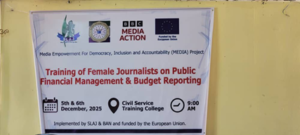
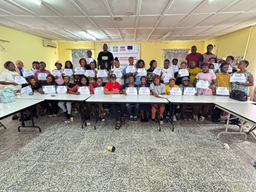
The Sierra Leone Association of Journalists (SLAJ), in partnership with BBC Media Action and funded by the European Union, has concluded a specialised training programme aimed at equipping female journalists with expertise in Public Financial Management (PFM) and budget reporting. The intensive two-day workshop in Freetown, facilitated by the Budget Advocacy Network (BAN), forms a key component of the Media Empowerment for Democracy, Inclusion and Accountability project, which seeks to strengthen media oversight of government expenditure and procurement.
SLAJ President, Alhaji Manika Kamara, underscored the initiative’s accountability focus, stating, “Accountability begins with knowledge. When journalists understand how public funds are planned, allocated, and spent, they are empowered to raise the right questions, demand transparency, and keep citizens informed.”
The programme, which aims to train 75 female journalists nationwide, also seeks to address gender disparities in specialised reporting. Kamara highlighted the project’s alignment with his manifesto pledge to expand opportunities for women in the sector, adding that mini-grants for investigative journalism on public finance will be awarded competitively.
BBC Media Action Project Manager, Alphonso Kamara, reinforced the strategic relevance of the training, noting that “empowering female journalists with practical knowledge on public finance is crucial for promoting accountability and deepening democratic participation.”
Facilitators from BAN guided participants through Sierra Leone’s PFM legal frameworks, the national budget cycle, and the interpretation of audit reports. Abu Bakarr Kamara of BAN stressed the critical role of the media in fiscal transparency: “PFM is not only for economists or policymakers. When journalists understand PFM laws, procurement rules, and audit findings, misuse of public resources becomes harder to conceal.”
Participant, Janet Sesay, welcomed the workshop’s practical approach, noting, “Many of us cover governance issues, but PFM concepts can be complex. This training breaks it down in a practical way. It will definitely improve the quality of our reporting and help us ask tougher, better-informed questions about how taxpayers’ money is used.”
Overall, the scheme represents a targeted investment in strengthening institutional capacity for monitoring public finances—an essential element of effective economic governance and investor confidence in Sierra Leone.